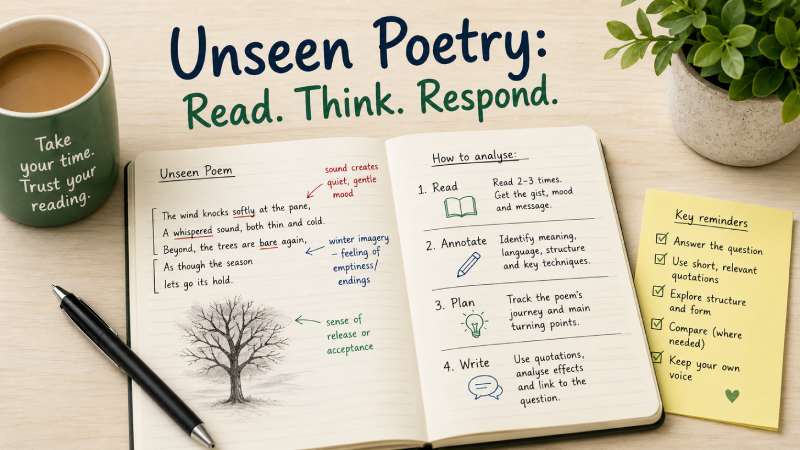
Let’s clear up the name first, because it trips people up. “Unseen poetry” doesn’t mean some mysterious, invisible genre of writing. It simply refers to a poem you haven’t studied, prepared, or even glanced at before you sit down to analyse it, usually in an exam hall with the clock ticking. The whole idea is to drop a fresh poem in front of you and see what you genuinely make of it, without notes, without a teacher’s interpretation rattling around your head, and without a memorised essay to fall back on. In a funny way, the term is a bit of a misnomer, since every poem is “unseen” the very first time we read it. What examiners really mean is “unseen and timed,” and that little word “timed” is where most of the pressure comes from.
Why Exam Boards Love It So Much
Here’s the honest reason this task exists: it’s almost impossible to fake. You can revise a set anthology poem to death, memorise quotes, and recite three pre-learned interpretations, but an unseen poem strips all of that away. It forces you to actually read, think, and respond in the moment. That’s exactly what examiners want to reward, real understanding rather than rehearsed knowledge. The poems chosen for these tasks are usually picked to be reasonably accessible, often dealing with familiar territory like family, nature, memory, loss, or growing up. So while it feels intimidating, the deck is quietly stacked in your favour. The poem isn’t designed to defeat you; it’s designed to give you something to say.
The First Read: Don’t Panic, Just Listen
When you first meet the poem, resist the urge to start scribbling immediately. Read it once, calmly, almost the way you’d listen to a song you’ve never heard. Don’t worry about techniques or terminology yet, just try to grasp the basic situation. Who’s speaking? Who are they talking to, if anyone? What’s actually happening, and how does the whole thing make you feel? That gut reaction matters more than students realise, because your first instinct is often closer to the heart of the poem than the over-thought version you’ll talk yourself into later. Read it a second time, and ideally a third. Each pass reveals a little more, and by the end of the third read, you’ll usually have a rough sense of the poem’s mood and direction.
Reading the Questions Before You Dive In
This is a small habit that pays off enormously. After your first read, glance at the actual question being asked. It sounds obvious, but plenty of students annotate furiously for ten minutes before realising they’ve focused on entirely the wrong thing. The question is basically a map; it tells you what the examiners want you to chase. If the question asks how the poet presents a particular feeling or attitude, then everything you note down should circle back to that. Letting the question guide your annotation saves time and keeps your eventual answer sharp and relevant, rather than a scattergun of unconnected observations.
Annotating Like You Mean It
Good annotation is where the real groundwork happens, and there’s a simple trick that makes a big difference. Try marking the poem into units of meaning, for instance by putting a small slash at each full stop, then reading each chunk as its own little idea. This stops you from reading line by line and missing how the thoughts actually flow. As you go, jot down the mood in one or two words, then add a quick personal comment on what a phrase suggests, and finally note any language or technique that reinforces your reading. Colour-coding helps if you’ve got time, but even without it, the goal is the same: by the end you should have a clear, coherent argument forming on the page rather than a mess of random underlining.
Finding the Poem’s Journey
Almost every poem worth analysing goes somewhere. It rarely sits in one mood from start to finish. So one of the most useful things you can do is track the journey: what idea or feeling does the poem open with, where does it shift, and what are you left holding at the very end? A poem might begin in joy and drift into anxiety, or start in confusion and arrive at quiet acceptance. Spotting that turning point, often called a volta, instantly lifts your analysis above the basic level, because you’re no longer just describing the poem; you’re showing how it moves and develops. Examiners love this because it proves you’ve read the whole thing as a single, evolving piece of writing.
Talking About Form and Structure (Without Sounding Forced)
Structure is the part students most often skip, yet it’s frequently where the easy marks live. You don’t need to count every syllable or name every metrical foot. Instead, ask simple, sensible questions. Why has the poet broken the lines where they have? Does the rhythm feel steady and controlled, or jagged and uneasy? Are the stanzas neat and tidy, or do they spill and fragment? The trick is always to link what you notice back to meaning. A poem about chaos that’s written in messy, irregular lines is doing something deliberate, and pointing that out shows real insight. One thoughtful comment on structure tied to the poet’s message is worth far more than three technical labels with nothing behind them.
Picking Quotes That Pull Their Weight
When it comes to evidence, quality and spread beat quantity every time. Aim to pull a handful of quotations from different parts of the poem, the beginning, the middle, and the end, rather than camping out in the first stanza. This shows you’ve engaged with the entire poem, not just the opening you understood most easily. Keep your quotes short and surgical; a few well-chosen words zoomed in on closely will always impress more than a sprawling chunk you barely explain. And remember, the quote itself is never the point. What matters is the analysis that follows it, where you unpick why the poet chose that particular word, image, or sound, and what effect it creates.
The Comparison Task: Where Most Marks Slip Away
Many exam boards pair the unseen analysis with a shorter comparison, where you weigh one poem against a second, thematically linked one. This is where a surprising number of marks quietly disappear, usually because students describe each poem separately instead of actually comparing them. The fix is straightforward: start comparing from your very first sentence. Words like “similarly,” “in contrast,” and “whereas” should be doing heavy lifting throughout. Pick out maybe one shared image and one difference in form or tone, then explore how each poet handles it differently. Keep it tight and focused; this section is usually shorter and often marked only on technique, so there’s no need to repeat everything from your main answer.
Building Your Personal Response
Examiners genuinely want to hear your voice, not a recycled “correct” interpretation. A personal response simply means you’ve thought about the poem and arrived at your own informed reading, supported by evidence. There’s rarely one single right answer, which is liberating once it clicks. If a poem strikes you as bittersweet rather than purely sad, say so, and then prove it with a line that backs you up. Confidence here is rewarded, as long as it’s rooted in the text. The strongest answers feel like a real reader making sense of something in front of them, weighing possibilities and committing to an interpretation, rather than reciting a formula.
Common Mistakes That Cost Easy Marks
A few avoidable slips crop up again and again. The first is feature-spotting, where students list techniques like a shopping list, “there’s a metaphor, there’s alliteration,” without ever explaining the effect. Naming a device earns almost nothing; analysing what it does earns everything. The second is ignoring the poem’s overall meaning in favour of tiny isolated details. The third is panic, leading people to either over-write a sprawling introduction or freeze entirely. Take a breath, trust your reading, and keep your eye on the question. Finally, don’t waste time worrying about whether you’ve “got it right.” The examiner is rewarding the thinking, not policing a hidden correct answer.
A Quick Word on Timing
Since the clock is the real enemy, treat time like a resource to be managed deliberately. Spend a few honest minutes reading and annotating before you write a word, because that investment makes the writing faster and far better. Roughly speaking, give the bulk of your time to the main analysis and a smaller, fixed slice to any comparison. Don’t let a single tricky line swallow your minutes; if something puzzles you, note it and move on. A complete, balanced answer always scores better than a brilliant opening that runs out of road halfway through.
FAQs
How do I analyse an unseen poem quickly in an exam?
Read it two or three times first to grasp the situation and mood, then check the question to focus your annotation. Mark the poem into units of meaning, track how the feeling shifts from start to end, and pull short quotes from across the poem. Spend a few minutes planning before writing, since that investment makes the actual answer faster and far sharper.
What’s the difference between unseen poetry and anthology poetry?
Anthology poems are ones you study and prepare in advance, so you can memorise quotes and interpretations beforehand. Unseen poetry is a poem you meet for the first time in the exam, with no notes or preparation, which tests your genuine close-reading skills rather than rehearsed knowledge. That’s exactly why examiners value it so highly.
Is there a “right answer” when analysing unseen poetry?
Not really. Examiners reward a thoughtful, informed personal response backed by evidence, not a single hidden interpretation. If you read a poem as bittersweet rather than simply sad, that’s perfectly valid as long as you support it with a line from the text. Confidence rooted in the poem itself scores far better than guessing what you think the marker wants.
Conclusion
Unseen poetry feels scarier than it is. Strip away the exam-hall nerves and it’s really just a close-reading exercise, you, a poem, and your own ability to think. The students who do well aren’t the ones who memorise the most; they’re the ones who stay calm, read carefully, follow the poem’s journey, and back up their ideas with sharp little quotes. Once you stop treating the poem as a trap and start treating it as a conversation, the whole task opens up. So next time a fresh poem lands in front of you, take that breath, read it like you mean it, and trust that you’ve got something worth saying. More often than not, you do.