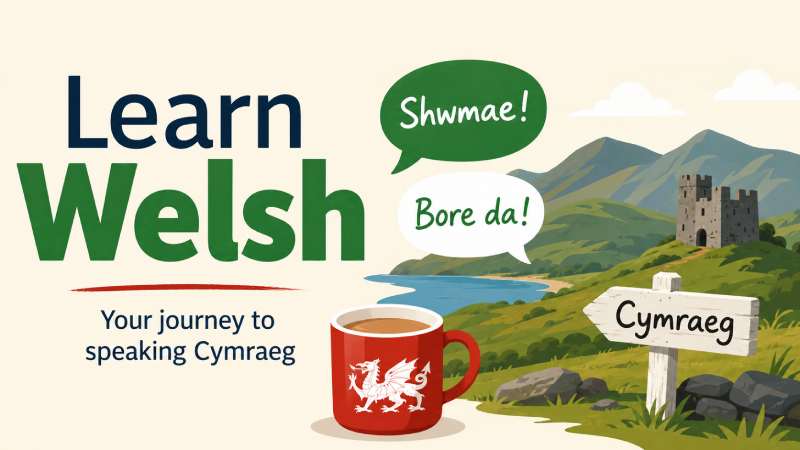
So you’ve decided to learn Welsh. Maybe you’ve got Welsh grandparents and you’re tired of nodding along at family gatherings. Maybe you fell in love with the place during a rainy holiday in Snowdonia. Or maybe you just heard the language somewhere and thought, “That sounds incredible, I want in.” Whatever brought you here, you’ve made a brilliant choice. Welsh is one of the oldest living languages in Europe, and learning it connects you to roughly 1,500 years of poetry, song, and stubborn cultural survival. The good news is that it’s far more learnable than its tongue-twisting reputation suggests. This guide will walk you through everything from why Welsh is worth your time to the exact resources that’ll get you speaking. Grab a panad (that’s a cuppa) and let’s get into it.
Why Bother Learning Welsh in the First Place?
Let’s be honest about something straight away: nobody needs to learn Welsh in the way some people learn Spanish for work or Mandarin for business. Almost every Welsh speaker also speaks fluent English. So the reasons to learn it are personal, cultural, and frankly a bit romantic, and that’s exactly what makes it special. Learning Welsh is an act of connection rather than obligation. You’re plugging yourself into a community of around 900,000 speakers and a heritage that includes the world’s oldest continuously published Welsh-language poetry tradition. There’s also a quietly practical side. The Welsh Government has set an ambitious target of reaching a million Welsh speakers by 2050, which means there’s genuine demand for bilingual skills in education, public services, broadcasting, and the arts across Wales. But honestly, the best reason is the feeling you get the first time you order a coffee in Welsh and the person behind the counter beams back at you in the same language. That moment is worth a hundred grammar drills.
Is Welsh Actually Hard to Learn?
Welsh has a fearsome reputation, mostly thanks to place names like Llanfairpwllgwyngyll and the famous double-L sound that makes newcomers sound like they’re clearing their throat. But here’s the reassuring truth: Welsh is more regular and predictable than English in almost every way that matters. The spelling is genuinely phonetic, so once you learn how each letter sounds, you can read any word aloud correctly, every single time. Compare that to English, where “though,” “through,” and “tough” all rhyme with absolutely nothing. The grammar does have a few quirks that surprise English speakers, the biggest being something called mutations, where the first letter of a word changes depending on the words around it. It sounds intimidating, but you’ll absorb the patterns naturally with exposure, the same way you learned not to say “a apple” as a child. The verb system is also wonderfully logical once it clicks. So no, Welsh isn’t easy in the sense of being effortless, but it’s absolutely not the impossible mountain people make it out to be. Consistency beats cleverness every time here.
The Two Welshes: Northern and Southern Dialects
One thing that catches new learners off guard is discovering there isn’t just one “Welsh.” The language has two broad regional varieties, often called Northern Welsh and Southern Welsh, and they differ in vocabulary, some pronunciation, and a handful of everyday phrases. For example, “now” is “rŵan” in the north and “nawr” in the south, and even the word for “milk” can shift. This sounds like a headache, but please don’t let it stress you out. The differences are roughly comparable to the gap between British and American English, totally mutually understandable, just with regional flavour. Most learning resources will pick one dialect and stick with it, and many let you choose your preference at the start. My advice is simple: pick whichever dialect is spoken where you live, where your family is from, or where you plan to visit most, and commit to it. You’ll naturally understand the other variety through exposure to Welsh-language television and radio. Trying to learn both at once just slows you down for no real benefit.
Getting Started: The National Centre for Learning Welsh
If you want a structured, official, and genuinely high-quality path into the language, the National Centre for Learning Welsh (Y Ganolfan Dysgu Cymraeg Genedlaethol in Welsh) is the gold standard. Set up in 2016 and funded by the Welsh Government, this is the body that coordinates standardised Welsh courses across the whole of Wales and even for learners abroad. What I love about their approach is the clear progression. You start at Entry level (Mynediad), then move through Foundation (Sylfaen), Intermediate (Canolradd), Higher (Uwch), and finally Proficiency (Gloywi). These levels broadly line up with the Common European Framework of Reference for Languages, so your progress is measurable and recognised. Courses are delivered through a network of regional providers, many of them attached to universities like Cardiff and Swansea, and you can choose between in-person classes, online sessions, or intensive courses depending on your schedule. For anyone who thrives with a teacher, a syllabus, and a bit of accountability, this is where I’d start. Their website, learnwelsh.cymru, is your launchpad.
Free Resources That Actually Work
Not everyone wants to commit to formal classes right away, and that’s completely fine. There’s a surprisingly rich ecosystem of free Welsh learning material out there, and some of it is genuinely excellent. The Learn Welsh Podcast, created by Jason Shepherd, is a beloved option that has pulled in tens of thousands of learners worldwide. It delivers structured lessons as both audio files and videos, completely free of charge, and it’s specifically designed for absolute beginners and returning learners who want to build real conversational confidence rather than just memorising word lists. Another gem is learn-welsh.net, a free website packed with over a hundred topic-based lessons aimed at both children and adults. Each topic combines a short introduction with interactive activities, little games, and quick tests, which makes it ideal for casual daily practice. Then of course there’s Duolingo, whose Welsh course is one of the best-regarded smaller-language courses on the platform, perfect for building a daily streak and keeping the language ticking over in your brain. The trick with free resources is to combine a couple of them rather than relying on just one.
Apps and Tech Tools for Modern Learners
We live in a golden age for language learning, and Welsh has quietly benefited from it more than most minority languages. Beyond Duolingo, there are dedicated apps worth knowing about. Bluebird offers thousands of interactive video lessons built around spaced repetition, the scientifically backed technique that times your reviews to lock vocabulary into long-term memory. Its listen-and-repeat format is brilliant for learning hands-free while you cook, commute, or go for a walk. For reference and translation, the Ap Geiriaduron app and the online Cysgair dictionary are indispensable companions, letting you look up words instantly without flipping through a paper dictionary. SaySomethingInWelsh is another standout, famous for its conversation-first method that throws you into speaking from lesson one and deliberately avoids drowning you in grammar early on. My honest recommendation is to treat technology as your daily glue rather than your whole strategy. Use an app for fifteen minutes a day to stay consistent, but make sure you’re also reading, listening to real Welsh media, and eventually speaking with actual humans. Apps build the foundation, but they can’t replace the messy joy of real conversation.
Immersion Without Moving to Wales
Here’s a secret that separates the learners who actually become fluent from those who plateau: immersion isn’t about geography, it’s about exposure. You don’t need to pack your bags and move to Aberystwyth, though it certainly wouldn’t hurt. You can flood your daily life with Welsh from wherever you are. Start with S4C, the Welsh-language television channel, which streams a huge range of programming online, much of it with subtitles you can toggle on and off as your confidence grows. BBC Radio Cymru gives you a constant stream of natural spoken Welsh to have humming in the background while you work. Switch your phone’s language settings to Welsh once you know the basics, follow Welsh-speaking accounts on social media, and find Welsh music that you genuinely enjoy, because singing along is one of the most underrated ways to nail pronunciation and rhythm. The goal is to make Welsh a normal, everyday part of your environment rather than a subject you study in isolation. The more your brain hears the language doing real work, the faster it stops feeling foreign.
The Power of Speaking From Day One
If I could press one piece of advice into the hands of every new Welsh learner, it would be this: start speaking far earlier than you feel ready to. The biggest mistake learners make is waiting until they feel “good enough” before opening their mouths, and that day never actually arrives. You learn to speak by speaking, awkwardly and imperfectly, and then a little less awkwardly each time. Welsh speakers are, in my experience, extraordinarily warm and encouraging towards learners, partly because they’re genuinely delighted that anyone is bothering to learn their language. Look for a “Siarad” scheme, which pairs learners with fluent speakers for informal conversation practice, or join a local Welsh-language meetup, often called a “sgwrs” group. If you can’t find one nearby, online communities and language exchange apps work brilliantly too. Embrace the cringe of those first few clumsy conversations, because every fluent speaker on earth was once exactly where you are, fumbling through and going slightly red in the face. The discomfort is temporary, but the skill is permanent.
Building a Daily Habit That Sticks
Motivation is fickle and willpower runs out, so the learners who succeed don’t rely on either. Instead, they build habits. The single most important factor in learning Welsh, or any language, is consistency over intensity. Twenty minutes every single day will take you dramatically further than a frantic three-hour session once a fortnight, because language lives in your long-term memory, and long-term memory is built through frequent, spaced repetition. Attach your Welsh practice to something you already do without thinking. Do a Duolingo lesson with your morning coffee, listen to a podcast episode during your commute, or review ten new words before bed. Keep your daily target small enough that you’ll never have a good excuse to skip it, because a streak you actually maintain beats an ambitious plan you abandon by February. Track your progress somewhere visible so you can see how far you’ve come on the days motivation dips. Treat the occasional missed day with kindness rather than guilt, just pick it back up tomorrow. Slow and steady genuinely wins this race.
Common Mistakes to Sidestep
Let me save you some time by flagging the potholes I see learners fall into again and again. The first is obsessing over grammar before you can hold a basic conversation. Grammar is important, but it makes far more sense once you’ve got real sentences rattling around your head to hang the rules onto. The second mistake is trying to learn both the northern and southern dialects simultaneously, which only creates confusion, so pick one and stay loyal. The third is consuming passively without ever producing, meaning learners who watch hours of S4C but never write or speak a word, then wonder why they can understand Welsh but can’t actually say anything. Output matters as much as input. The fourth trap is perfectionism, the deadly belief that you must say everything flawlessly, which keeps people silent and stalls their progress for years. And finally, there’s resource-hopping, constantly chasing the next shiny app instead of working steadily through one good course. Pick your tools, trust the process, and put in the reps. Awareness of these traps is half the battle of avoiding them.
How Long Until You’re Fluent?
This is the question everyone asks, and the honest answer is: it depends entirely on you. Fluency isn’t a finish line you cross on a particular date, it’s a spectrum you slide along. That said, here’s a realistic picture. With consistent daily practice of around twenty to thirty minutes, most people can hold simple, satisfying conversations within six months to a year. Comfortable, flowing conversational fluency typically takes somewhere between two and three years of steady effort, faster if you live in a Welsh-speaking community or have someone to practise with regularly. The pace depends on how often you practise, how much you immerse yourself, and crucially how willing you are to speak badly before you speak well. Don’t let the timeline discourage you, because the journey is genuinely enjoyable, and you’ll hit small, thrilling milestones constantly along the way. The first time you understand a whole sentence on the radio, the first joke you crack in Welsh, the first dream you have in the language. Each of those wins makes the next stretch of road lighter.
Here’s the SEO package for the article.
FAQs
How long does it take to learn Welsh?
With around 20 to 30 minutes of daily practice, most people can hold simple conversations within six months to a year, while comfortable conversational fluency usually takes two to three years. Your pace depends mostly on consistency and how often you actually speak rather than any natural talent.
Can I learn Welsh for free?
Absolutely. The Learn Welsh Podcast, learn-welsh.net, and Duolingo all offer solid free courses, and you can immerse yourself at no cost through S4C television and BBC Radio Cymru. Combining a couple of free tools daily works far better than relying on just one.
Should I learn northern or southern Welsh?
Pick whichever dialect matches where you live, where your family is from, or where you plan to visit most, then commit to it. The differences are roughly like British versus American English, fully understandable either way, so learning both at once only slows you down.
Conclusion
Learning Welsh is one of those quietly rewarding pursuits that gives back far more than you put in. It opens a door to a culture of extraordinary depth, connects you with some of the warmest and most welcoming speakers you’ll ever meet, and offers the simple, deep satisfaction of keeping an ancient language alive and thriving in the modern world. You don’t need to be a natural linguist, you don’t need to move to Wales, and you certainly don’t need to wait until you feel ready. All you need is a little consistency, a willingness to make mistakes out loud, and the right mix of resources to keep you moving forward. Start with whatever suits your style, whether that’s the structured courses from the National Centre for Learning Welsh, a free podcast on your commute, or a daily app habit, and then layer in real Welsh media and real conversations as your confidence grows. The road to Cymraeg is patient and forgiving, and it’s been walked by thousands of learners before you who started exactly where you are now. So take that first step today. Pob lwc, and welcome to the journey. You’re going to love it.