If you’ve spent any time around primary schools in the UK over the last decade, you’ve probably heard a teacher mention Literacy Tree at some point, usually with a slightly relieved expression. It’s become one of those names that travels by word of mouth in staffrooms, the kind of thing one teacher recommends to another over a lukewarm cup of tea. But what is it, really? Is it a curriculum? A planning tool? A teaching philosophy? The honest answer is that it’s a bit of all three, stitched together by one stubborn belief: that great books should sit at the very centre of how children learn to read and write. Let’s dig into what makes it tick, why so many schools have leaned on it, and whether the hype holds up.
What Literacy Tree Actually Is
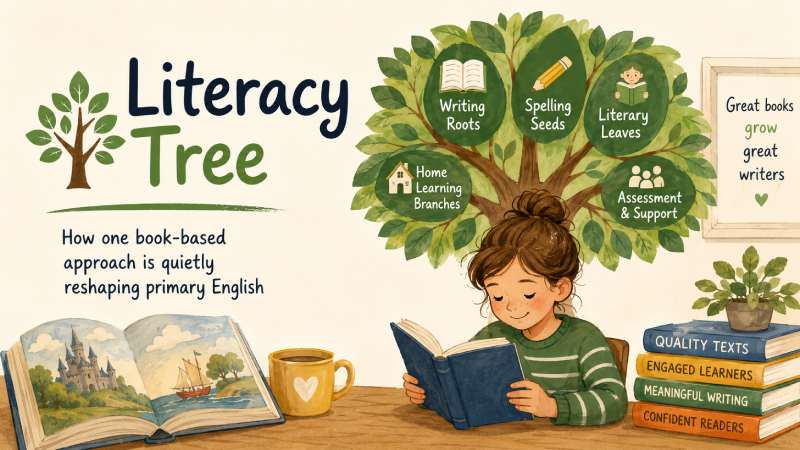
At its core, Literacy Tree is an ed-tech platform built specifically for primary literacy, and it lives in two places at once, the website and a companion app. Through these, teachers can get their hands on planning sequences, teaching tools, assessment frameworks, training, and even spaces to share examples of children’s writing. It was created by teachers for teachers, which is one of those phrases that gets thrown around a lot in education marketing, but in this case it genuinely shows in the texture of the resources. They feel like they were made by people who have actually stood in front of thirty seven-year-olds at half past two on a Friday afternoon. The whole thing is anchored by a single, distinctive idea they call “Teach Through a Text,” and almost everything else they offer is a branch growing out of that central trunk.
The Big Idea: Teaching Through a Text
So what does “Teach Through a Text” actually mean in practice? Put simply, instead of teaching writing skills in isolation, with a disconnected grammar worksheet here and a random comprehension exercise there, the approach uses a high-quality book as the engine for everything. The text becomes the reason children write, the source of their vocabulary, the context for their spelling, and the spark for their discussions. The thinking is that when a child is genuinely gripped by a story, character, or idea, the writing that follows has a real purpose and a real audience behind it, rather than just being an exercise to fill a page. Literacy Tree is also deliberate about the books it chooses, leaning hard into diverse, high-quality literature so that children encounter a wide range of voices and experiences. It’s a deceptively simple philosophy, but it reorders the whole logic of an English lesson, and that reordering is exactly what teachers tend to fall in love with.
Writing Roots: The Backbone of It All
If Teach Through a Text is the philosophy, then Writing Roots are the workhorse that brings it to life day to day. These are the book-based planning sequences that form the absolute backbone of the platform, and they’re designed to give comprehensive curriculum coverage while constantly nudging children to write with a clear audience and purpose in mind. Each Writing Root takes a single quality text and maps out a sequence of lessons, often opening with what the team calls a “discovery point,” those first immersive lessons designed to drop children right into the world of the book and get a genuine buzz going before any formal writing begins. Crucially, these plans guide teachers day by day, so there’s no staring at a blank planning document at nine o’clock at night trying to invent a fortnight’s worth of lessons from scratch. Many of the Writing Roots also include mixed-age planning tucked into the back of each sequence, offering ideas for the year groups before and after, which is a quiet lifesaver for anyone teaching a mixed-age class or trying to support children who need extra scaffolding.
Spelling Seeds: Making Spelling Stick Without the Tedium
Spelling is one of those areas that can quickly turn into a soul-crushing routine of word lists copied out three times and forgotten by Monday. Literacy Tree’s answer to this is Spelling Seeds, and the clever bit is that they don’t operate in a vacuum. Each Seed is tied directly to a corresponding Writing Root and uses the very same text the children are already reading and writing about, so the spelling work feels like a natural extension rather than a bolt-on. The sequences run anywhere from two to five sessions, matching the length of the Writing Root they accompany, and they teach spelling and vocabulary in context through open-ended investigations and chances to practise and apply in genuinely meaningful situations. The objectives and spelling words line up with the text being studied while still ticking off the necessary phonics and spelling requirements where they’re relevant. Teachers often note that children sometimes don’t even clock that they’re learning new spelling rules, because everything is wrapped inside a story they already care about, which is honestly the dream when it comes to making anything stick.
Literary Leaves: Growing Critical Readers
Reading comprehension gets its own dedicated strand in the form of Literary Leaves, and this is where Literacy Tree leans into the “whole book” experience. Rather than feeding children isolated extracts ripped out of context, Literary Leaves offer sequenced activities that walk children all the way through complete books, with the explicit aim of building reading comprehension and shaping critical, thoughtful readers. The texts used here aren’t just novels either; the collection pulls in poetry collections and high-quality non-fiction, all connected back to the Writing Roots through shared Literary Themes. That thematic threading is one of the subtler strengths of the whole system, because it means a child’s reading and writing aren’t living in separate silos. They reinforce one another, and the more a school commits to the approach, the more those connections compound over a year. It’s the kind of joined-up thinking that’s easy to describe and surprisingly hard to actually pull off, which is part of why the platform earns its keep.
Home Learning Branches and the Bits That Tie It Together
Learning doesn’t stop at the classroom door, and Literacy Tree has built a strand specifically for the journey home in the shape of Home Learning Branches. These extend the work into the home with resources spanning writing, reading comprehension, spelling, vocabulary, and further reading opportunities, and they’re frequently used as homework that actually connects to what’s happening in class rather than feeling like busywork. Around these core strands sit a collection of supporting materials too, including Classroom and Subject Leader Trunks packed with helpful visuals and toolkits, curriculum maps organised around literary themes, whole-school and catch-up Writing Roots for children who need to bridge a gap, and mixed-age planning resources. Together, these turn what could be a loose set of lesson plans into something closer to a genuine whole-school ecosystem, where a Reception teacher and a Year 6 teacher are, in a meaningful sense, pulling in the same direction.
The App: Planning and Assessment in Your Pocket
In recent years Literacy Tree has put real effort into its companion app, and it’s worth talking about because it addresses one of teaching’s quieter pain points: the sheer cognitive load of juggling planning, marking, and assessment. The app is free to download and works for anyone with a Free, Individual, or School membership, and it’s explicitly framed around protecting teachers’ work-life balance, which is a refreshingly honest pitch. Inside, teachers can annotate and adapt any plan in their account, dropping comment bubbles wherever they like to personalise a sequence for their own class, with an autosave function that means edited plans sync straight back to the website ready to print or use. Beyond annotation, the app lets teachers capture and tag examples of children’s work to individuals or groups, and then link that captured evidence directly to assessments. It essentially closes the loop between planning, teaching, and evidence-gathering, all without the printing, photocopying, and re-planning marathon that usually eats up evenings.
Assessment Without the Headache
Assessment is the part of teaching that most reliably induces a low hum of dread, partly because it so often feels disconnected from the actual teaching. Literacy Tree tries to soften this with bespoke assessment tools and clear progression steps built right into the platform, including a reading and writing assessment system that teachers use to track where children are and what they need next. The assessment functionality dovetails with the app, so the writing a teacher captures during a normal lesson can be tied back to specific assessment points rather than being judged in isolation at some artificial assessment week. The goal, as the team frames it, is to make sure learning genuinely sticks and that standards are being met, without turning assessment into a separate, joyless administrative event. For subject leaders trying to get a coherent picture of literacy across a whole school, having assessment baked into the same system that drives planning and teaching is a genuine advantage, because the data actually reflects what children have been doing rather than a snapshot from a one-off test.
Training, CPD, and the Human Support Side
It would be a mistake to think of Literacy Tree purely as a library of downloadable resources, because a huge part of what it offers is professional development. The platform is wrapped in embedded CPD, consultancy, and planning support designed to build teachers’ subject knowledge and confidence over time, not just hand them a plan and wish them luck. There are year-specific training courses, often half-day sessions led by named members of the team, that walk teachers through the practical strategies of using high-quality children’s literature as the primary route into English. These courses are particularly aimed at people who are brand new to the approach or moving to a different year group, and they cover the pedagogy alongside concrete modelling of how grammar, spelling, vocabulary, and modelled writing all contribute to purposeful writing within a sequence. Higher membership tiers even fold in regular CPD sessions for English subject leaders, which signals that the team understands change in a school doesn’t happen by buying resources alone; it happens when the adults feel genuinely equipped and supported.
Memberships and Who It’s Really For
Literacy Tree is squarely aimed at primary schools, but it’s flexible about how schools and individuals actually get on board. There’s a free membership tier that lets curious teachers dip a toe in, an individual membership for solo teachers wanting full access for their own classroom, and school memberships that open up the platform to whole teams, typically covering access for up to thirty members along with the full sweep of book-based resources. For larger organisations, the team also builds bespoke memberships, so whether you’re a tiny village school or part of a sprawling multi-academy trust, there’s usually a configuration that fits. This tiered, scalable approach is part of why the platform has spread the way it has, because it doesn’t force a small school to swallow a costly all-or-nothing package, while still giving big trusts the consistency and coverage they need across many sites.
A Few Honest Caveats Worth Keeping in Mind
No tool is a magic wand, and it’s only fair to flag a few realistic considerations. Adopting Literacy Tree wholesale is a genuine shift in pedagogy, not just a swap of worksheets, so schools that treat it as a quick fix and skip the training tend to get less out of it than those who lean into the CPD and give the approach time to bed in. Because the model is so text-led, leaders also need to be comfortable with the book choices and confident that the diverse literature on offer suits their community, and some teachers initially find the move away from standalone skills lessons takes a mental adjustment. There’s also an ongoing cost to membership to factor into already tight budgets. None of these are dealbreakers, and plenty of schools clearly feel the investment pays off, but going in with eyes open and a willingness to commit properly is the difference between a transformative year and a folder of unused plans.
FAQs
What is Literacy Tree and how does it work?
Literacy Tree is a UK ed-tech platform for primary English built around its “Teach Through a Text” approach, where a high-quality book drives the reading, writing, spelling and vocabulary lessons. Teachers access ready-made planning sequences, an app, and assessment tools through one connected system.
Is Literacy Tree worth it for schools?
For schools willing to commit to the pedagogy and the embedded training, most find it pays off, since it cuts planning time, joins reading and writing together, and lifts engagement. It works best as a whole-school shift rather than a quick fix, so the value depends on proper buy-in.
Does Literacy Tree cover reading, writing and spelling?
Yes, all three sit in dedicated strands: Writing Roots for purposeful writing, Literary Leaves for reading comprehension through whole books, and Spelling Seeds for spelling and vocabulary in context. Home Learning Branches then extend the same texts into homework.
Conclusion
What’s striking about Literacy Tree, when you stand back from the individual features, is how coherent the whole thing is. The Writing Roots, Spelling Seeds, Literary Leaves, and Home Learning Branches aren’t a random assortment of products; they’re deliberately grown from a single root idea, that children learn to read and write best when they’re doing it through stories worth caring about. Add in an app that genuinely tries to lighten teachers’ loads, assessment tools that connect to real classroom evidence, and a serious commitment to ongoing training, and you end up with something more thoughtful than a typical resource bank. It isn’t a shortcut, and it asks real buy-in from a school to work properly. But for teachers who are tired of disconnected lessons and want literacy to feel alive again, both for their pupils and for themselves, Literacy Tree offers a compelling, well-considered answer. And in a profession where good intentions often crash into impossible workloads, a tool built around both children’s imagination and teachers’ wellbeing is a genuinely refreshing thing to find.