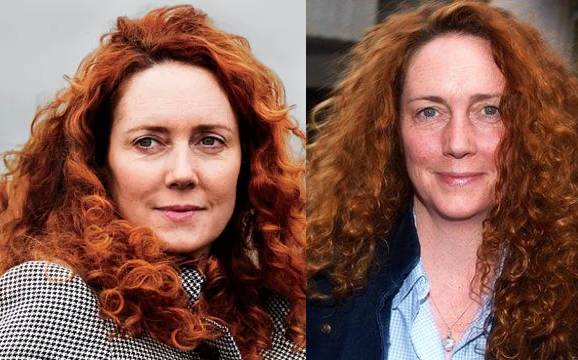
If you have followed British newspapers at any point over the last thirty years, you have almost certainly come across the name Rebekah Wade, even if you knew her better by her married name. She is one of those rare figures who managed to become as famous as the celebrities her papers covered, and arguably more powerful than most of the politicians whose careers her headlines helped make or break. Born plain Rebekah Mary Wade in a small village near Warrington, she rose from making cups of tea at a local paper to running Rupert Murdoch’s entire British newspaper empire. Along the way she picked up two famous husbands, survived the biggest media scandal in modern British history, walked free from a high-profile criminal trial, and then strolled straight back into the top job as if nothing had happened. This is the full story of who Rebekah Wade is, where she came from, and how a girl from Cheshire ended up at the very centre of British public life.
Who Is Rebekah Wade, Really?
Rebekah Wade is the birth name of the woman the world now knows as Rebekah Brooks, the chief executive of News UK, the company behind The Times, The Sunday Times, and The Sun. She was born on 27 May 1968, which makes her a Gemini and, more importantly, makes her part of a generation of journalists who came up through the rough-and-tumble world of the 1980s and 1990s tabloid press. What sets her apart is not just the speed of her climb but the sheer staying power she has shown. Editors come and go, executives get pushed out, and scandals usually end careers for good. Rebekah managed to bend all of those rules, and she did it while remaining famously private about her own life. People who have worked with her describe a woman who is charming, sharp, and almost impossible to read, someone who rarely gives interviews and almost never speaks publicly about her personal history. That mystery is part of what has kept people searching her name for decades.
Early Life: Growing Up as Deborah Wade’s Daughter
To understand Rebekah Wade, you have to start with the family that raised her. She was the only child of John Robert Wade and Deborah Wade, an ordinary working family living in the Cheshire countryside outside Warrington. Her parents ran a tree-pruning and gardening business, and her father, John Robert Wade, was at one point listed on official documents as a tug boat operator before moving into the gardening trade. By all accounts this was a modest, hard-working household rather than a wealthy or well-connected one, which makes her later access to prime ministers and media billionaires all the more striking. Deborah Wade, her mother, has long been described as the person Rebekah remained closest to, particularly after John and Deborah’s marriage ended in divorce. There is something quietly telling about that bond. For a woman who became notorious for her ability to charm and manage powerful men, the steadiest relationship in her early life appears to have been with her mother. The Wade family never sought the spotlight, and Deborah Wade in particular has remained almost entirely out of public view, which fits the pattern of a daughter who learned early how to control a story and decide exactly what the world got to see.
The Teenager Who Knew Exactly What She Wanted
Most teenagers have only the vaguest sense of what they want to do with their lives. Rebekah was not most teenagers. By the age of fourteen she had already decided she was going to be a journalist, and she set about making it happen with a focus that would define her entire career. She started turning up at her local newspaper, making the tea and helping out with whatever odd jobs needed doing, simply to get her foot in the door. It is a small detail, but it tells you everything about how she operated. She did not wait for permission or for the perfect opportunity; she inserted herself into the world she wanted to be part of and made herself useful until she became indispensable. She attended Appleton Hall High School, a state comprehensive in Appleton near Warrington that had once been a grammar school. People who knew her back then remember someone who was more emotionally intelligent than academically bookish, a person who instinctively understood how to read others and get what she wanted out of them. That talent, far more than any qualification, became the foundation of her success.
Building a Career and Climbing the Ladder
After her early local newspaper experience, Rebekah cut her teeth as a reporter before making the move that would change everything. In 1989 she joined News International, the British arm of Rupert Murdoch’s media empire, starting out as a feature writer for the Sunday magazine attached to the News of the World. There is a curious footnote to her background here. Her entry in Who’s Who once suggested she had studied at the Sorbonne in Paris, though she never claimed a degree from it and later declined to clarify the details. Whatever the truth of her formal education, it clearly mattered far less than her instincts. From that magazine job she began a relentless rise, learning the trade of tabloid journalism from the inside and building the kind of internal relationships and reputation that get people promoted. Within just over a decade she would go from feature writer to editor of a national newspaper, a speed of ascent that was almost unheard of and that left plenty of older, more experienced colleagues trailing in her wake.
Youngest Editor on Fleet Street: The News of the World Years
In 2000, Rebekah Wade was appointed editor of the News of the World, and in doing so she became the youngest editor of a British national newspaper. Think about what that meant. She was barely past thirty, in charge of one of the best-selling and most aggressive Sunday papers in the country, with millions of readers and an enormous appetite for scoops, scandals, and celebrity exposés. It was a job that chewed people up, and she handled it with the confidence of someone twice her age. During her time at the helm she pushed campaigns that connected the paper to its readers on an emotional level, the kind of populist journalism that made the News of the World a genuine force in British life. Her editorship was not without controversy, and some of the campaigns she championed drew fierce criticism, but there was no arguing with her ability to command attention and drive sales. Those three years established her as one of the most formidable figures in the industry and set her up for an even bigger prize.
Breaking the Glass Ceiling at The Sun
In 2003 came the move that cemented her legend. Rebekah Wade was named editor of The Sun, Britain’s largest-selling daily newspaper, and she became the first woman ever to hold that role. In an industry that was overwhelmingly male, especially at the top, this was a genuine milestone. The Sun was not just a newspaper; it was a political and cultural institution, capable of swaying public opinion, influencing elections, and making life very uncomfortable for anyone it decided to target. Running it put her at the absolute centre of British power. She held the editorship until 2009, and during that period she navigated the tricky politics of the paper with characteristic skill. One of the more telling episodes involved the paper’s famous Page Three feature. Despite her reputation as a co-founder of Women in Journalism, Page Three remained in place during her editorship, in line with the wishes of the man who owned the paper, and she even ran a robust campaign defending it against a prominent political critic. It was a reminder that her loyalty to the Murdoch business model usually won out over any personal misgivings.
The Campaigns That Defined Her Editorship
Whatever you think of tabloid journalism, it is impossible to discuss Rebekah Wade’s editorships without acknowledging the campaigns she drove, because they genuinely changed things. She was the force behind The Sun’s support for Help for Heroes, the charity that raised enormous sums for wounded British service personnel and became a national cause. She also spearheaded a campaign that led to the introduction of so-called Sarah’s Law, giving parents the ability to ask police whether someone with access to their children had a record of child sex offences. These were the kinds of emotionally resonant, reader-driven crusades that she understood instinctively, and they showed how a popular newspaper could turn its huge readership into a tool for real policy change. Critics argued that her papers could be cruel, intrusive, and politically loaded, and there is plenty of evidence to support that view. But the campaigns demonstrated the other side of the coin, the way she grasped that a tabloid’s true power lay in its connection to ordinary people and the issues that moved them.
Becoming CEO of News International
In 2009, Rebekah stepped up from the editor’s chair to the boardroom, becoming chief executive of News International, the company that ran Murdoch’s British newspapers. This was a remarkable promotion that confirmed her status as Murdoch’s most trusted lieutenant in the United Kingdom. As chief executive she was no longer just shaping headlines; she was running the entire operation, overseeing some of the most influential publications in the country and helping to steer them through the difficult early years of the digital transition. During this period the business pushed into paid digital subscriptions, with The Times becoming a pioneer in charging readers for online content, a strategy that looked risky at the time but anticipated the direction the whole industry would eventually take. For two years she sat at the very top of British print media, a position of extraordinary influence for anyone, let alone a woman who had started out making tea at a local paper. And then, almost overnight, it all came crashing down.
Marriage and Personal Life: Ross Kemp and Charlie Brooks
Before getting to the scandal, it is worth understanding the personal life that ran alongside her career, because it kept her in the celebrity pages as much as the business ones. In June 2002 she married Ross Kemp, the well-known English actor best remembered for playing hard man Grant Mitchell in EastEnders, who later reinvented himself as a documentary presenter and author. It was a high-profile celebrity marriage that put the editor herself firmly in the spotlight she usually reserved for others. The relationship did not last, and Wade and Kemp divorced in 2009. That same year she married Charlie Brooks, a former racehorse trainer, newspaper columnist, and one-time amateur jockey from a more traditionally upper-class English background. It was through this marriage that she took the surname Brooks, which is why so much of her later public life is filed under Rebekah Brooks rather than Rebekah Wade. The couple later had a daughter, Scarlett, born in 2012. By marrying into the world of country sports and racing, the girl from Daresbury completed a social journey that took her a very long way from her parents’ tree-pruning business.
The Phone-Hacking Scandal
In 2011, the story that had been bubbling for years finally exploded. Allegations emerged that journalists at the News of the World had hacked into the voicemails of all sorts of people in pursuit of stories, and the scandal reached a horrifying peak with claims involving the phone of a murdered schoolgirl. The public revulsion was immediate and overwhelming. As the chief executive who had previously edited the very paper at the centre of the storm, Rebekah Brooks became a lightning rod for public anger. The leader of the Labour Party called on her to consider her position, the Prime Minister indicated he would have accepted her resignation, and the grieving family at the heart of the worst allegations demanded that she step down. The pressure became impossible to withstand. She resigned from News International, and in her statement she spoke of feeling a deep responsibility for the harm that had been done. The fallout was enormous. The News of the World, a paper with a history stretching back well over a century, was shut down entirely, and the affair triggered a major public inquiry into the culture and ethics of the British press.
The Trial and the Acquittal
Resignation was only the beginning of her ordeal. Rebekah Brooks was arrested as part of the police investigations into the scandal and eventually stood trial at the Old Bailey, London’s most famous criminal court, in one of the most closely watched legal proceedings in recent memory. For someone who had spent her career putting other people on the front pages, suddenly being the defendant in a nationally televised media circus must have been a surreal and brutal experience. The trial dragged on for months, and the eventual verdict surprised many observers who had assumed she would go down with the ship. In 2014 she was cleared of all the charges against her. The acquittal was complete, and it transformed her situation overnight from disgraced executive facing possible prison to a free woman with her reputation legally, if not entirely publicly, restored. Whatever people believed in their hearts about the culture she had presided over, the jury had spoken, and that gave her the opening for one of the most audacious comebacks in British corporate history.
The Comeback: Back at the Top of News UK
Most people written off as thoroughly as Rebekah Brooks had been in 2011 would never have come anywhere near the top of the industry again. She is not most people. In September 2015, just over a year after her acquittal, she returned to run the company, now rebranded as News UK, once again as chief executive. The man behind the decision was the same media billionaire who had backed her throughout, persuading a reportedly reluctant Brooks to take the reins of his British operation once more. The appointment was controversial, as you would expect, but it was also a stunning demonstration of loyalty and resilience. Since returning she has overseen a sprawling business that includes The Times, The Sunday Times, The Sun, and The Sun on Sunday, along with various radio and digital ventures, and she has pushed hard on the company’s online strategy and audience growth. She reports directly to the chief executive of News Corp and has remained in the role ever since, making her one of the longest-serving and most powerful figures in the entire British media landscape. As of today she is still firmly in charge, which is a remarkable thing to be able to say about someone who was being written off completely just over a decade ago.
The Murdoch Connection
You cannot tell the story of Rebekah Wade without talking about Rupert Murdoch, because the two careers are deeply intertwined. Her relationship with the media mogul has often been described as exceptionally close, and it is widely understood to be one of the key reasons she has been able to survive setbacks that would have ended anyone else. Murdoch has long valued loyalty and instinct over conventional credentials, and Brooks embodied both qualities to an unusual degree. She understood his papers, she understood his politics, and she understood how to deliver the kind of results he wanted. That alignment, combined with genuine mutual trust, explains why he was willing to bring her back when most boards would have run a mile. Critics see this relationship as a symbol of everything that is wrong with concentrated media power, the cosy bond between a billionaire owner and an executive who will protect his interests. Supporters see a talented operator being rewarded for her ability. Either way, the Murdoch connection is the thread that runs through her entire career.
What Rebekah Wade’s Story Tells Us About British Media
Step back from the individual details and the career of Rebekah Wade becomes a kind of x-ray of the British media itself. Her rise shows how the tabloid world rewarded raw talent, hustle, and emotional intelligence over formal education and pedigree, which is genuinely admirable in some ways. Her campaigns show how a popular newspaper could channel the feelings of millions of readers into real political change. But the scandal that nearly destroyed her also exposed the dark underside of that same world, the relentless intrusion, the blurred ethical lines, and the cosy relationships between press barons and politicians that the public inquiry later examined in painful detail. Her acquittal and comeback then raised uncomfortable questions about accountability and power at the very top. In one career you can trace the ambition, the influence, the controversy, and the resilience that have defined Fleet Street for decades. That is precisely why people keep searching her name and why her story still matters far beyond the gossip pages.
FAQs
Who is Rebekah Wade and what is she known for?
Rebekah Wade, now known as Rebekah Brooks, is a British media executive and former newspaper editor. She is best known for becoming the youngest editor of the News of the World, the first woman to edit The Sun, and the long-serving chief executive of News UK.
Are Rebekah Wade and Rebekah Brooks the same person?
Yes, they are the same person. Rebekah Wade is her birth name, and she took the surname Brooks after marrying Charlie Brooks in 2009, which is why her later career appears under the name Rebekah Brooks.
Who are Rebekah Wade’s parents and husbands?
Her parents are John Robert Wade and Deborah Wade, who ran a tree-pruning business in Cheshire. She was first married to actor Ross Kemp from 2002 to 2009, and later married former racehorse trainer Charlie Brooks in 2009.
Conclusion
Rebekah Wade, the only child of John Robert Wade and Deborah Wade from a quiet corner of Cheshire, built one of the most extraordinary careers in modern British media. From making tea at a local paper as a teenager to becoming the youngest editor of a national newspaper, the first woman to edit The Sun, and ultimately the chief executive of an entire newspaper empire, she repeatedly broke through barriers that stopped almost everyone else. Her two marriages, first to actor Ross Kemp and then to Charlie Brooks, kept her in the public eye, and her central role in the phone-hacking scandal made her one of the most scrutinised figures in the country. Yet she survived a criminal trial, walked free, and returned to the very top of the industry in a comeback few could have predicted. Whatever your view of the journalism she produced or the world she represents, there is no denying that Rebekah Wade is a genuinely consequential figure whose story captures the ambition, the power, and the contradictions of the British press. Decades after she first walked into a newsroom, she remains right where she has always seemed determined to be: at the centre of it all.