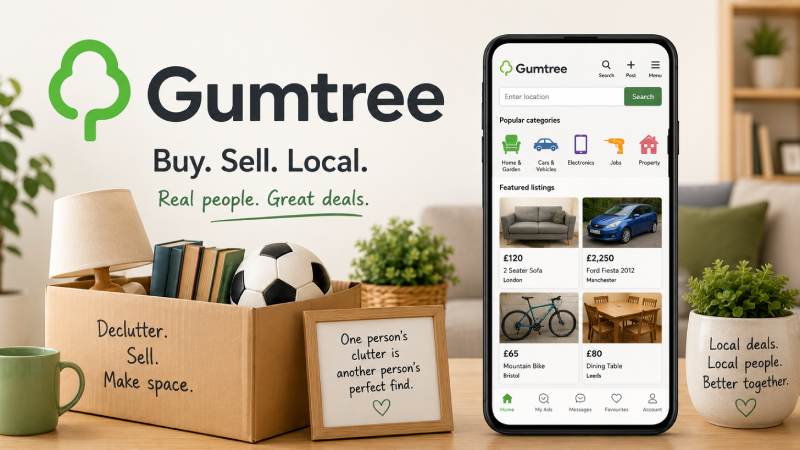
If you have ever cleared out a garage, hunted for a cheap sofa, or tried to offload a car that had seen better days, chances are someone has told you to “just stick it on Gumtree.” That little phrase says a lot. Over the past couple of decades, Gumtree has gone from a scrappy noticeboard for homesick expats to one of the most recognisable classifieds platforms in the English-speaking world. It is the kind of site people use without thinking twice, the digital equivalent of a community bulletin board that somehow ended up serving millions. In this article, I want to walk you through what Gumtree actually is, where it came from, how it works, and why it still matters in an era dominated by slick e-commerce giants. Grab a coffee, because there is more to this humble marketplace than meets the eye.
What Exactly Is Gumtree?
At its core, Gumtree is an online classified advertisement and community website, which is a fancy way of saying it is a place where ordinary people post listings to buy, sell, rent, hire, and offer services to each other. Think furniture, second-hand cars, flat shares, job openings, pets, gardening tools, and the occasional oddball item that makes you raise an eyebrow. Unlike a traditional retailer, Gumtree does not hold any stock or sell anything itself. It simply connects the person who has something with the person who wants it, then steps back and lets them sort out the details. Many listings are completely free to post, while others carry a small fee depending on the category and region, which is part of why the platform has stayed so popular with casual sellers who just want to declutter without paying hefty commissions.
The Story Behind the Name
Here is a bit of trivia that surprises most people: Gumtree was not born as a shopping site at all. It launched in March 2000 in London, founded by Michael Pennington and Simon Crookall, and its original purpose was to help Australians, New Zealanders, and South Africans settle into life in the UK capital. These were folks arriving in a new city who needed accommodation, work, and a few friendly faces, and the site gave them a single place to find all three. The name itself is a clever nod to that mission. “Gum tree” is the everyday term for eucalyptus, a species closely tied to all three of those countries, so it became a kind of shared symbol linking those communities together. The founders also liked that a tree has roots and branches, which felt like a fitting metaphor for the grassroots community they were trying to build. From that thoughtful little origin story grew something far bigger than anyone probably imagined at the time.
How Gumtree Grew Into a Giant
The early 2000s were a wild time for the internet, and classifieds were one of the hottest spaces around. Gumtree caught the wave at just the right moment. As word spread among expat circles and then the wider public, the site expanded well beyond its original niche of newcomers to London. People realised it was simply a handy, no-nonsense way to trade locally, and the listings ballooned to cover practically every category you could imagine. The real turning point came in May 2005, when eBay’s classifieds division acquired Gumtree as part of a larger deal that bundled it with a couple of other classified sites. That acquisition gave Gumtree serious backing, resources, and reach, allowing it to scale rapidly and plant its flag in new markets. By 2010 it had become the UK’s largest website for local community classifieds and was pulling in millions of unique visitors every single month, cementing its place as a genuine internet heavyweight rather than a passing fad.
Gumtree Around the World
Although Gumtree was born in London and remains strongly associated with Britain, it never stayed confined to one country. The platform spread to several markets, each running its own dedicated regional site tailored to local tastes and needs. In Australia, Gumtree became enormously popular and now positions itself as one of the country’s biggest marketplaces for buying and selling cars, furniture, electronics, jobs, and real estate. South Africa has its own thriving version too, where it is marketed as a go-to spot for snagging deals on quality second-hand goods and stretching a tight budget further. This regional approach is smart because it means a user in Sydney sees listings relevant to Sydney, while someone in Cape Town gets results that make sense for Cape Town. The shared brand name carries trust and familiarity, but the underlying experience is localised so it feels genuinely useful rather than like a generic global template dropped onto every country.
What You Can Actually Find on Gumtree
The sheer variety on Gumtree is honestly part of its charm. On any given day you might stumble across a barely used dining table, a reliable old hatchback, a litter of puppies looking for homes, a room to rent in a shared house, or a local handyman advertising his services. The platform has increasingly leaned into being the marketplace for the home, helping people furnish, fix, and sort out their living spaces affordably. Categories typically span furniture and homeware, vehicles and parts, technology and gadgets, clothing and fashion, property and rentals, and a robust section for tradespeople and local services. For bargain hunters, it is a treasure trove, because the prices on pre-loved goods are often a fraction of retail. For sellers, it is a fast way to turn clutter into cash without the hassle of shipping or fees that eat into the profit. That combination of breadth and simplicity keeps people coming back.
How the Buying and Selling Process Works
One reason Gumtree has endured is that it never overcomplicated the basics. Selling something is refreshingly straightforward: you create a listing with a title, a description, a price, and a few photos, then publish it for local buyers to discover. Interested people message you through the platform, and from there you arrange the rest, whether that means a cash exchange in a car park or a buyer collecting a wardrobe from your living room. Many transactions happen face to face, which is a deliberate part of the model, since a huge share of activity is hyper-local. Buyers can browse by category, filter by location and price, and reach out directly to sellers without any middleman taking a cut of the deal. There are paid upgrades available, such as featuring an ad to give it more visibility, but the fundamental experience of posting and replying remains accessible to everyone. This low barrier to entry is exactly why so many casual users feel comfortable jumping on.
The Apps and the Modern Experience
These days, very few people sit at a desktop to flog an old bookshelf, and Gumtree has adapted accordingly. The platform offers dedicated apps for both iOS and Android, designed to make the whole process feel effortless from your phone. The pitch is simple and relatable: getting your home sorted should be a breeze, whether you are clearing out to make space, selling to earn a little extra cash, or searching for a trusted local service. Snapping a photo of an item and listing it in a couple of minutes while sitting on the sofa is exactly the kind of frictionless experience modern users expect. The mobile-first approach also suits the local, on-the-go nature of classifieds, since you can browse listings nearby, message a seller, and arrange a pickup all from the palm of your hand. It is a far cry from the text-only noticeboard of the early 2000s, yet the underlying spirit of connecting neighbours is exactly the same.
Staying Safe on Gumtree
No honest discussion of Gumtree would be complete without addressing the elephant in the room, which is safety. Any platform that lets strangers connect to trade money and goods will inevitably attract a few bad actors, and Gumtree is no exception. Scammers are a relentless, industry-wide headache rather than a problem unique to one site, and Gumtree has openly acknowledged this, encouraging users to report suspicious accounts to its help desk so action can be taken. The practical advice for users is mostly common sense but worth repeating. Meet in person and in public when you can, inspect items before handing over money, be wary of buyers or sellers who push you off the platform too quickly, and treat deals that look too good to be true with healthy suspicion. Using the in-app messaging rather than sharing personal contact details early on adds a layer of protection too. It also helps to trust your instincts, because if a conversation feels off or a person seems unusually pushy, there is no shame in walking away from the deal entirely. Approached sensibly, the vast majority of Gumtree transactions go smoothly and pleasantly, but staying alert is simply part of the deal with any peer-to-peer marketplace, and a few minutes of caution can save you a lot of regret later.
Why Gumtree Still Matters in 2026
In a world saturated with polished online stores and one-click delivery, you might wonder why a classifieds site from the year 2000 is still relevant. The answer comes down to a few things that big retailers simply cannot replicate. First, there is the local angle, since Gumtree thrives on connecting people within the same town or city, which makes it ideal for bulky items that are a nightmare to ship. Second, there is sustainability, because buying and selling second-hand keeps usable goods out of landfill and gives them a second life, something an increasing number of shoppers genuinely care about. Third, there is the price, as pre-loved goods almost always cost less than buying new, which matters more than ever when household budgets are squeezed. Add to that the sheer ease of decluttering and making a bit of cash, and you have a formula that stays useful regardless of how many shiny new apps come along. Gumtree occupies a particular space in people’s lives, the practical, neighbourly, slightly old-school corner of the internet that just works.
A Few Tips for Getting the Most Out of It
If you are thinking of diving in, a handful of small habits can make a big difference to your results. When selling, decent photos in good lighting genuinely matter, because a clear, well-lit image will always attract more interest than a blurry shot taken in a dim room. Write honest, detailed descriptions that mention any flaws upfront, since this builds trust and saves everyone wasted time. Price your items competitively by checking what similar listings are going for, and be open to a little friendly haggling, as it is part of the culture. When buying, respond promptly to listings you like because good deals move fast, and do not be shy about asking questions before you commit. Above all, keep your communication polite and your arrangements clear, whether you are confirming a collection time or agreeing on a price. These little courtesies are what keep the whole ecosystem running smoothly and pleasantly for everyone involved.
FAQs
Is Gumtree free to use for buying and selling?
Yes, for the most part. Posting many listings on Gumtree costs nothing, which is why it is so popular with casual sellers clearing out their homes. Some categories or premium upgrades, like featuring an ad for extra visibility, carry a small fee, but browsing and buying are free, and there are no commissions taken from the actual sale.
How do I avoid scams on Gumtree?
Stick to a few simple habits and you will be fine. Meet sellers in person and in a public place, inspect items before handing over any money, and keep your conversations inside Gumtree’s messaging rather than sharing personal details too early. Be cautious of anyone pushing you to pay upfront or rushing the deal, and report suspicious accounts to the help desk.
Is Gumtree available outside the UK?
Absolutely. While Gumtree started in London, it runs dedicated regional sites in markets including Australia and South Africa, each tailored to local listings and prices. So whether you are in Sydney or Cape Town, the platform shows you nearby deals rather than a generic global feed.
Conclusion
Gumtree is one of those quietly remarkable corners of the internet that has woven itself into everyday life without much fanfare. What began as a friendly noticeboard for homesick expats in London has grown into a sprawling, much-loved marketplace spanning multiple countries and countless categories, all while holding on to the simple idea at its heart: connecting people who have something with people who want it. It is not the flashiest platform out there, and it has its share of scammers to watch out for like any open marketplace, but its enduring popularity speaks to how genuinely useful it is. Whether you are furnishing a first flat on a shoestring, decluttering before a move, hunting for a reliable local tradesperson, or just enjoying the thrill of a good bargain, Gumtree offers a refreshingly human, local, and affordable way to do it. More than two decades on, that humble gum tree has put down some seriously deep roots, and it does not look likely to be uprooted any time soon.