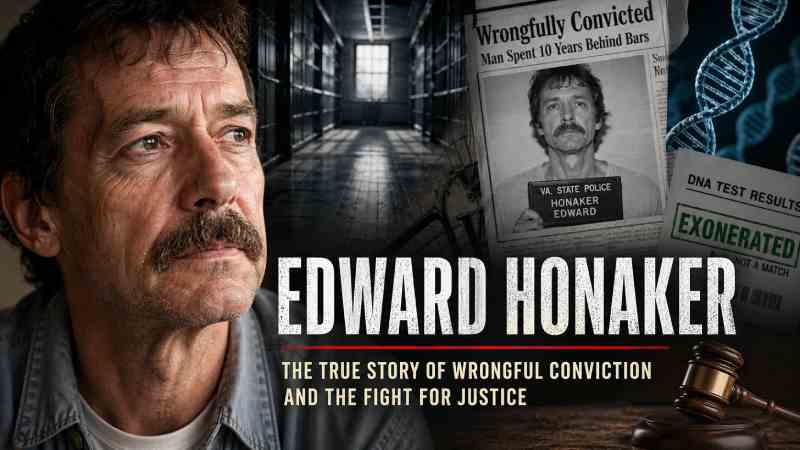
The story of Edward Honaker is one that continues to echo through discussions of justice, fairness, and the reliability of evidence in criminal trials. It is not simply the account of one man’s suffering, but a wider reflection of how legal systems—despite their safeguards—can sometimes fail. His case stands as a stark reminder that truth does not always prevail in courtrooms, especially when flawed methods and human error come into play.
In the mid-1980s, Honaker was convicted of a brutal crime he did not commit. He spent nearly a decade behind bars before modern DNA testing proved his innocence. By then, the damage had already been done—years lost, reputation shattered, and a life permanently altered. Yet, his eventual exoneration also became a turning point in the growing movement to reform forensic science and improve legal standards.
Early Life and Background
Edward Honaker was born in 1950 in the United States. Before his arrest, he lived a relatively ordinary life, working hard and maintaining close ties with his community. Like many individuals who later become victims of wrongful conviction, there was nothing particularly remarkable about his early years—no criminal background that would suggest involvement in serious offences.
He was known as a working man, someone trying to build a stable future. His life, however, would take a dramatic and devastating turn in the mid-1980s when he became entangled in a criminal investigation that would ultimately change everything.
The Crime That Changed Everything
In 1984, a violent attack involving kidnapping and sexual assault occurred in Virginia. The crime was serious and deeply distressing, prompting swift action from law enforcement. Authorities were under pressure to find and convict the perpetrator, and within a relatively short time, suspicion fell on Edward Honaker.
The investigation relied heavily on eyewitness testimony and forensic techniques that were widely accepted at the time. Unfortunately, both of these elements would later prove to be deeply flawed.
Despite maintaining his innocence, Honaker was arrested and charged with multiple serious offences. The case moved quickly through the legal system, culminating in a trial that would define the next decade of his life.
The Trial and Conviction
In 1985, Edward Honaker was convicted and sentenced to multiple life terms, along with additional years in prison. The severity of the sentence reflected the seriousness of the crime, but it also underscored how confident the court was in the evidence presented.
Several key factors contributed to his conviction:
Eyewitness Identification
The victim identified Honaker as the attacker. Eyewitness testimony can be powerful in court, often carrying significant weight with juries. However, decades of research have since shown that such identifications are not always reliable. Memory can be influenced by stress, suggestion, and the passage of time.
Forensic Hair Analysis
Another critical piece of evidence was hair comparison analysis. At the time, experts testified that hair found at the crime scene matched Honaker’s. This method was considered scientifically sound, but it has since been widely discredited due to its lack of precision and objectivity.
Weak Alibi Evidence
Honaker had an alibi, but it was not strong enough to overcome the prosecution’s narrative. Without definitive proof, his claims were overshadowed by the confidence placed in eyewitness and forensic testimony.
The result was a conviction that would later be recognised as a grave miscarriage of justice.
Life Behind Bars
After his conviction, Edward Honaker began serving his sentence in prison. The experience was harsh, isolating, and deeply unjust. For an innocent man, imprisonment carries a unique psychological burden—the knowledge that one is suffering for a crime not committed.
During his years in prison, Honaker continued to assert his innocence. He sought legal assistance and appealed his case, but progress was slow. At the time, there were limited avenues for challenging convictions based on new scientific evidence.
Nevertheless, he remained determined. His persistence would eventually prove crucial in bringing his case to the attention of organisations dedicated to addressing wrongful convictions.
The Role of Advocacy Groups
Honaker’s case gained support from groups committed to investigating potential miscarriages of justice. Organisations such as Innocence Project and Centurion Ministries played a significant role in re-examining the evidence.
These organisations specialise in reviewing cases where individuals claim innocence, often focusing on those where biological evidence might still exist. They recognised that advances in DNA testing could provide a definitive answer in Honaker’s case.
Their involvement marked a turning point. What had once seemed like a closed case was now open to re-evaluation through modern scientific methods.
DNA Testing and Exoneration
By the early 1990s, DNA testing had become a powerful tool in forensic science. Unlike earlier methods, it offered a high degree of accuracy in identifying individuals based on biological evidence.
In Honaker’s case, preserved evidence from the original investigation was subjected to DNA analysis. The results were clear and unequivocal: the DNA did not match Edward Honaker.
This finding effectively dismantled the prosecution’s case. The forensic evidence that had once been used to convict him was now proven unreliable. Combined with the known weaknesses of eyewitness identification, the conviction could no longer stand.
In 1994, after spending approximately ten years in prison, Edward Honaker was granted a full pardon. He was finally recognised as an innocent man.
The Aftermath of Release
Freedom, however, did not erase the past. After a decade behind bars, Honaker faced the challenge of rebuilding his life from scratch. The world had moved on, and he had lost valuable years that could never be recovered.
He worked to establish a new life, eventually starting a business and forming personal relationships. While he managed to find some stability, the emotional and psychological impact of his wrongful conviction remained.
For many exonerees, reintegration into society is a complex and ongoing process. The stigma of a criminal conviction—even one that has been overturned—can linger, affecting employment opportunities, social relationships, and mental health.
Compensation and Recognition
Following his exoneration, there were discussions about financial compensation for the years he had lost. Some jurisdictions provide compensation to individuals who have been wrongfully convicted, recognising the profound harm caused by such errors.
In Honaker’s case, compensation was proposed, but like many similar situations, it could not fully account for the damage done. Time lost cannot be returned, and the experience of wrongful imprisonment leaves lasting scars.
Nevertheless, his case received attention as an example of why compensation systems are necessary and why they must be fair and accessible.
Broader Implications for the Justice System
The case of Edward Honaker had far-reaching implications beyond his personal story. It highlighted several systemic issues that continue to be relevant today.
The Fallibility of Eyewitness Testimony
Research has shown that eyewitness identification is one of the leading causes of wrongful convictions. Honaker’s case contributed to growing awareness of this problem and encouraged reforms in how such evidence is collected and presented.
Limitations of Forensic Science
Hair comparison analysis, once considered reliable, has since been discredited. His case demonstrated the dangers of relying on forensic methods that lack scientific validation.
Importance of DNA Evidence
The use of DNA testing in Honaker’s exoneration underscored its value as a tool for ensuring justice. It has since become a standard part of many criminal investigations, helping both to convict the guilty and exonerate the innocent.
Need for Legal Reform
Cases like Honaker’s have driven calls for reform in areas such as evidence standards, appeals processes, and access to post-conviction testing. They have also highlighted the importance of independent organisations that can review potential miscarriages of justice.
Legacy and Continued Relevance
Edward Honaker’s story remains relevant today because wrongful convictions have not been entirely eliminated. While advances in science and legal practice have reduced the risk, errors still occur.
His case serves as both a warning and a source of hope. It warns of the consequences of relying on flawed evidence and procedures, but it also shows that justice can eventually be achieved, even if delayed.
For legal professionals, policymakers, and the public, his story is a reminder of the need for vigilance and continuous improvement within the justice system.
FAQs
What evidence proved Edward Honaker innocent?
DNA testing of biological evidence conclusively showed it did not match Edward Honaker, overturning the earlier forensic claims.
Why is Edward Honaker’s case important today?
It highlights flaws in eyewitness testimony and outdated forensic methods, influencing modern justice reforms.
Did Edward Honaker receive justice after release?
He was fully pardoned and freed, but like many wrongful conviction cases, the lost years could never be fully restored.
Conclusion
The story of Edward Honaker is a powerful example of how justice can falter and how it can, eventually, be restored. His wrongful conviction exposed critical weaknesses in the legal system, from unreliable eyewitness testimony to flawed forensic practices. At the same time, his exoneration demonstrated the transformative power of scientific advancement, particularly DNA testing.
While his release brought a measure of justice, it could never fully compensate for the years he lost. His experience continues to influence discussions about legal reform, forensic standards, and the importance of safeguarding against wrongful convictions. Ultimately, Edward Honaker’s legacy is one of resilience, truth, and the ongoing pursuit of a fairer justice system.