Community buildings should be places where people feel welcome and safe. From community centres and places of worship to synagogues and faith schools, these premises can welcome large numbers of visitors while also accommodating staff, children, volunteers and members of the public. This combination makes thoughtful security planning particularly important.
Improving security does not have to mean creating an intimidating environment. The objective should be to introduce proportionate measures that protect people and property while allowing the building to continue serving its community.
Start With a Thorough Security Assessment
Every building has different vulnerabilities, so improvements should begin with an assessment of the site. Entrances, exits, windows, car parks, boundaries and less frequently used access points should all be reviewed.
Managers should consider how the building is used throughout the week. A faith school may experience concentrated activity at arrival and collection times, while a synagogue or community centre may have changing visitor numbers depending on services and events.Understanding these patterns makes it easier to determine where additional protection is appropriate.
Strengthen Doors and Entrances
Doors are among the most important elements of physical building security. An entrance must allow authorised people to move conveniently through the property while helping prevent unauthorised access.
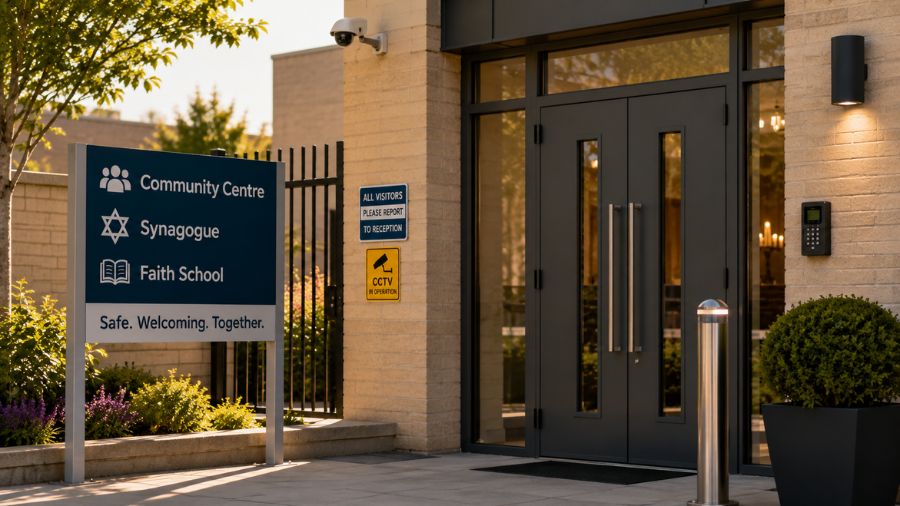
However, standard doors may not provide sufficient resistance in buildings where a security assessment identifies an elevated risk. This is where purpose-designed security doorsetscome in. They can incorporate reinforced construction, secure locking systems, access control and protected vision panels.Real-world projects involving security doorsets for synagogues can provide useful insight when considering how specialist doors may be incorporated into faith and community buildings.
When choosing doors, it is worth looking beyond appearance and considering independently tested security performance. Standards such as LPS 1175 assess a doorset’s ability to resist deliberate physical attack using specified tools and attack durations.
Introduce Appropriate Access Control
Not everyone entering a community building necessarily needs access to every area. Dividing premises into zones can provide an additional layer of protection.Electronic access control can restrict staff rooms, offices, classrooms, storage areas and other sensitive spaces while leaving appropriate communal areas accessible.
Visitor management procedures are equally important. Staff and volunteers should know how visitors are admitted, where they should report and what to do if someone attempts to enter a restricted area.
Improve Visibility Around the Site
Good visibility can contribute significantly to security. For example, external lighting should cover entrances, paths, car parks and areas around the perimeter without creating unnecessary blind spots.CCTV may also form part of the overall security strategy. Cameras should be positioned according to an assessment of the premises rather than simply installed wherever convenient.Landscaping should also be considered. Overgrown vegetation around entrances or boundaries doesn’t just look unwelcoming, but it can reduce visibility and create concealed areas.
Prepare Staff and Volunteers
Physical improvements are most effective when the people using the building understand the security procedures around them.Staff and volunteers should know how to respond to suspicious behaviour, security alerts and emergencies. They should also understand access control arrangements and the importance of keeping designated doors secured.Procedures should be practical enough to follow during everyday activities rather than so complicated that people routinely work around them.
Review Security Regularly
Security is not a one-time project. Buildings change, patterns of use evolve, and equipment can deteriorate. Community organisations should therefore review their arrangements regularly and after significant changes to the premises.
Doors, locks, alarms, CCTV, lighting and access control equipment should be maintained, while procedures should be updated when necessary.
For synagogues, faith schools and other community buildings, effective security is ultimately about creating a balanced environment. Combining suitable physical protection with sensible access management, staff awareness and regular assessments can help protect the people who rely on these important spaces without losing the welcoming character that makes them valuable to their communities.