Set along the dramatic east coast of the Isle of Lewis, North Tolsta is one of the most distinctive villages in the Outer Hebrides. Though modest in size, it carries an identity that stretches far beyond its population. Surrounded by Atlantic swells, sweeping sands and rugged moorland, the settlement represents the quiet resilience of island life in Scotland’s far north-west.
Geography and Setting
A Village on the Edge of the Atlantic
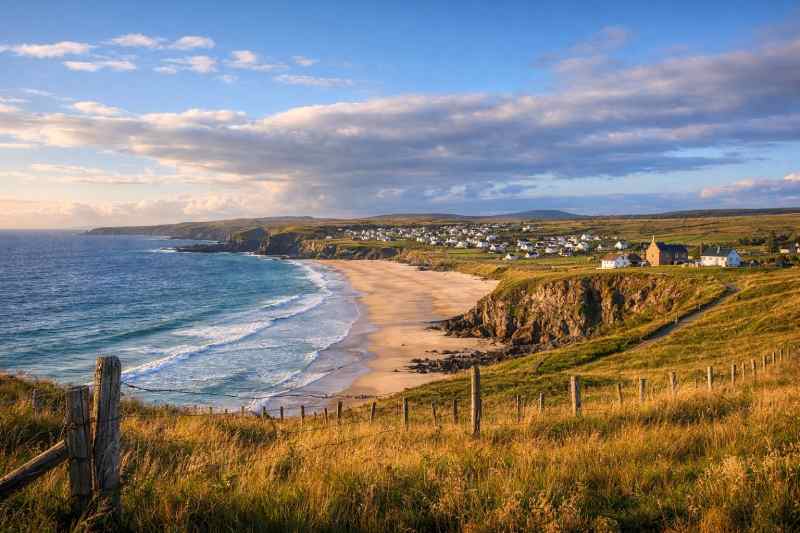
North Tolsta lies roughly five miles north-east of Stornoway, the principal town of Lewis. The village stretches in a linear fashion along the coastline, following the curve of Traigh Mhòr, one of the island’s most striking beaches. The scenery is immediately arresting: vast skies, pale sands and dark Atlantic waters create a powerful visual contrast that shifts constantly with the light.
The geography is defined by its exposure. The east coast here faces the open North Sea and the wider Atlantic beyond. Winter storms can be fierce, while summer days may feel astonishingly calm and luminous. The shifting weather patterns are not simply background; they shape daily life, architecture and local habits.
Traigh Mhòr and the Caves
Traigh Mhòr, meaning “big beach” in Gaelic, is the centrepiece of the local coastline. At low tide, it stretches impressively, revealing firm sands that are ideal for long walks. At the far end of the beach, a series of sea caves carved by centuries of tidal movement can be explored with caution. These caves have long inspired local folklore and are a favourite destination for adventurous walkers.
The combination of beach, cliffs and headland provides one of the most scenic coastal settings in Lewis. Visitors often remark on the sense of space and solitude that defines North Tolsta, particularly outside peak summer months.
Historical Roots
Norse Origins and Early Settlement
The name Tolsta is believed to derive from Old Norse, reflecting the Viking presence that once dominated the Hebrides. Like much of Lewis, the area bears clear evidence of Scandinavian influence, both in place names and in archaeological remains.
Settlement in North Tolsta can be traced back centuries. Crofting, a traditional system of small-scale agriculture unique to the Highlands and Islands, shaped the development of the village. Families worked narrow strips of land, balancing subsistence farming with fishing and seasonal labour.
Community and Conflict
The First World War left a deep mark on many Hebridean communities, and this village was no exception. A significant proportion of local men enlisted, and the losses were keenly felt in a small settlement where everyone knew one another. Memorials across Lewis testify to the scale of sacrifice from remote island communities.
Throughout the twentieth century, migration posed another challenge. Like many rural Scottish areas, young people often left in search of work on the mainland. Yet despite population changes, North Tolsta has retained a strong sense of identity and continuity.
Culture and Gaelic Heritage
The Role of the Gaelic Language
Gaelic remains an important part of life in Lewis, and North Tolsta is no exception. While English is widely spoken, Gaelic continues to be used in homes, community gatherings and church services. It is more than a language; it carries stories, songs and a worldview shaped by land and sea.
Cultural traditions in the village reflect this heritage. Music, particularly traditional Hebridean singing, plays a role in social life. Storytelling and oral history have long been central to preserving local memory.
Religious and Social Life
Churches have historically formed the heart of community life in many island villages. Sunday observance in Lewis has long been known for its seriousness and devotion. Although contemporary practice is more varied than in the past, faith remains an important part of the local fabric.
Community events, fundraising efforts and voluntary initiatives reveal a society that values cooperation. In remote settings, mutual support is not merely cultural; it is practical and necessary.
Economy and Modern Developments
Crofting and Local Livelihoods
Crofters in North Tolsta continue to manage land in small parcels, often keeping sheep and cultivating limited crops. While few households rely solely on crofting today, the practice remains symbolically and practically important.
Fishing historically provided income for many families, though changes in the industry have reduced its dominance. Today, employment is often linked to Stornoway, with residents commuting for work in education, healthcare and public services.
Community Energy Initiatives
One of the most notable modern developments has been the community’s involvement in renewable energy. A locally operated wind turbine generates income that is reinvested in projects benefiting residents. This initiative reflects a broader trend in the Highlands and Islands, where communities take ownership of resources to sustain local life.
Such efforts demonstrate how North Tolsta balances tradition with innovation. Renewable energy projects provide financial resilience while aligning with environmental stewardship.
Wildlife and Natural Environment
Birdlife and Marine Species
The coastline around the village supports a rich array of wildlife. Seabirds such as kittiwakes, fulmars and skuas nest along nearby cliffs. Inland moorland provides habitat for species including golden eagles and hen harriers.
Marine life is equally compelling. Dolphins and porpoises are occasionally sighted offshore, and seals often rest along rocky outcrops. For nature enthusiasts, North Tolsta offers opportunities for observation without the crowds found in more commercialised destinations.
Seasonal Changes
Each season brings a distinct atmosphere. Spring introduces longer days and returning birdlife. Summer offers extended twilight and mild evenings. Autumn transforms the moorland into hues of bronze and gold. Winter, though harsh at times, reveals a raw beauty as waves crash dramatically against the shore.
This cyclical rhythm reinforces the intimate relationship between residents and their environment.
Visiting North Tolsta
Travel and Accessibility
Reaching North Tolsta requires a journey, but that is part of its appeal. Travellers typically arrive in Stornoway by ferry from Ullapool or by plane from mainland Scotland. From there, a short drive along coastal roads leads to the village.
Public transport options are limited, so hiring a car provides the greatest flexibility. The road itself offers scenic views, setting the tone for the landscape ahead.
Activities and Experiences
Walking is the primary activity. Coastal routes towards Tolsta Head provide sweeping views across the Minch. Beachcombing, photography and birdwatching are popular pursuits. Those seeking solitude will find it in abundance.
Visitors should respect local conditions, particularly tidal movements near sea caves. The Atlantic is powerful and unpredictable, and safety awareness is essential.
Architecture and Built Environment
Houses in North Tolsta range from traditional whitewashed cottages to more modern dwellings. Many older structures reflect simple, functional design suited to the climate: thick walls, small windows and sheltered entrances.
The linear layout of the village creates a sense of openness. Properties are often spaced with land between them, reinforcing the impression of space and quiet. Agricultural sheds and croft buildings remain visible reminders of traditional livelihoods.
Education and Community Services
The closure of small rural schools has been a challenge across the Highlands and Islands. Like many villages, North Tolsta has experienced changes in local education provision. Children now travel to larger schools in nearby areas.
Despite such shifts, community spirit remains strong. Local initiatives aim to maintain shared spaces and ensure that the village continues to thrive socially as well as economically.
The Experience of Living Here
Life in North Tolsta demands adaptability. Weather can disrupt plans, distances to services require forethought and winter darkness can feel intense. Yet residents frequently speak of the rewards: safety, tranquillity and connection to landscape.
Community ties are close. In smaller settlements, anonymity is rare. While this can feel unusual to newcomers, many find comfort in the shared awareness and mutual support.
Digital connectivity has improved in recent years, making remote working increasingly feasible. This has allowed some individuals to choose North Tolsta not only for heritage reasons but also for lifestyle preferences.
FAQs
Where exactly is North Tolsta located?
North Tolsta is situated on the east coast of the Isle of Lewis in the Outer Hebrides, approximately five miles north-east of Stornoway.
Is North Tolsta suitable for tourists?
Yes, particularly for those seeking quiet landscapes, coastal walks and authentic island life rather than busy attractions or nightlife.
What is the best time of year to visit?
Late spring and summer offer longer daylight hours and milder weather, though each season has its own distinctive appeal.
Are there facilities in the village?
The village has basic amenities, but most larger services are located in Stornoway, which is a short drive away.
Is Gaelic still spoken locally?
Gaelic remains part of community life in Lewis, including in and around North Tolsta, although English is widely used.
Conclusion
North Tolsta stands as a powerful example of Hebridean resilience and identity. It is shaped by Atlantic winds, Norse heritage and crofting traditions that continue to influence daily life. Though small in scale, it offers depth in culture, landscape and community spirit.
For visitors, the appeal lies not in grand attractions but in subtle experiences: the sound of waves across Traigh Mhòr, the shifting light over moorland and the warmth of island hospitality. For residents, North Tolsta represents continuity, belonging and a way of life intimately connected to sea and land.