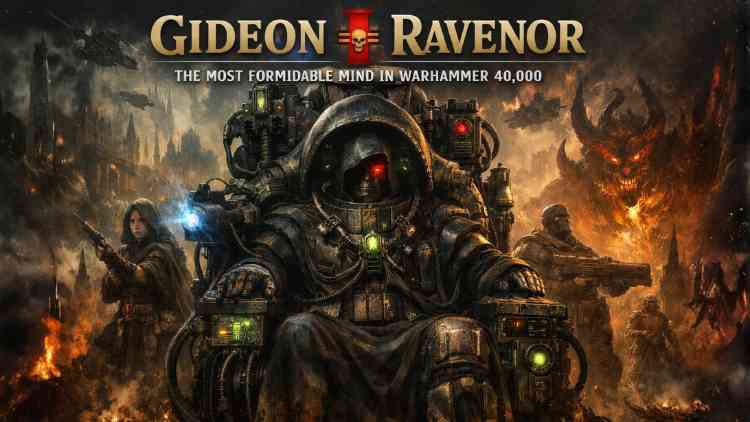
Gideon Ravenor stands as one of the most compelling and intellectually complex figures in the Warhammer 40,000 universe. Unlike warriors defined by brute strength or generals celebrated for battlefield victories, Ravenor is remembered for the sheer power of his mind, the moral weight of his decisions, and the quiet authority he exerts over allies and enemies alike. His story is not one of simple heroism. It is a layered narrative of survival, sacrifice, and relentless duty in a universe where hope is scarce and compromise is often fatal.
The origins of Gideon Ravenor
Gideon Ravenor’s early life remains deliberately obscure, a narrative choice that enhances his mystique. What is known is that he emerged as a gifted individual within the Imperium of Man, quickly identified for his extraordinary psychic potential. Such abilities are both a blessing and a curse in the Warhammer universe, where psykers are feared as much as they are needed.
Ravenor’s formative years within the Inquisition shaped him profoundly. Trained as an Interrogator, he learned not only investigative skills but also the art of restraint. Unlike many Imperial servants who rely on overt displays of force, Ravenor was taught to think several steps ahead, anticipating consequences long before action was taken. This intellectual discipline became the foundation of his later reputation.
His apprenticeship instilled in him a deep understanding of the Imperium’s fragility. He learned early that enemies were not always obvious, and that corruption often wore familiar faces. These lessons would later define his approach as an Inquisitor in his own right.
A life defined by catastrophe and survival
One of the most defining moments in Gideon Ravenor’s life was the catastrophic incident that left him permanently incapacitated. Gravely injured during a devastating attack, his body was almost entirely destroyed. Survival was only possible through radical technological intervention, resulting in his confinement within a life-sustaining force chair.
In a universe obsessed with martial prowess, this could have marked the end of his relevance. Instead, it became the beginning of his legend. Ravenor’s physical limitations forced him to rely entirely on intellect, perception, and psychic strength. The chair did not diminish him; it refined him.
This transformation also added a powerful symbolic dimension to his character. Ravenor embodies the idea that true strength is not rooted in physical form but in resilience and adaptability. His survival is not portrayed as a miracle, but as a consequence of indomitable will.
The force chair: more than a life support system
The force chair that sustains Gideon Ravenor is often misunderstood as a mere medical device. In reality, it is a sophisticated fusion of arcane technology and psychic amplification. It allows Ravenor to interact with the physical world, defend himself, and project his presence with unmistakable authority.
More importantly, the chair becomes an extension of his identity. It reinforces the notion that Ravenor has transcended normal human limitations. While others wield weapons, he commands reality through thought and will. The chair symbolises his evolution from a conventional agent of the Inquisition into something far rarer: a living intellect weaponised against the Imperium’s enemies.
Rather than distancing him from humanity, the chair paradoxically deepens his connection to it. Ravenor’s dependence on others for mobility and protection fosters trust, delegation, and emotional awareness, traits often absent in more physically dominant characters.
Psychic mastery and mental discipline
Gideon Ravenor is widely regarded as one of the most powerful psykers in Imperial history. His abilities extend across telepathy, telekinesis, and precognition, but raw power is only part of the story. What sets Ravenor apart is control.
He uses his psychic gifts with surgical precision, avoiding excess whenever possible. In a setting where uncontrolled psychic energy often leads to catastrophe, Ravenor’s restraint is remarkable. He listens more than he speaks, observes more than he acts, and intervenes only when necessary.
His telepathic communication with allies allows him to coordinate complex operations silently and efficiently. This mental network fosters unity and loyalty within his retinue, creating a sense of shared purpose that transcends conventional command structures.
Leadership through intellect and trust
Ravenor’s leadership style is fundamentally different from many other figures in Warhammer 40,000. He does not dominate through fear or blind obedience. Instead, he inspires loyalty through trust, competence, and mutual respect.
His team is carefully selected, each member valued for unique skills rather than expendability. Ravenor understands that people are not tools, but assets whose effectiveness depends on morale and belief in the mission. This philosophy stands in stark contrast to the Imperium’s often brutal disregard for individual lives.
He delegates authority with confidence, empowering his agents to act independently while remaining guided by his strategic oversight. This decentralised approach allows his operations to adapt quickly to changing circumstances, a crucial advantage in the unpredictable conflicts of the 41st millennium.
Moral complexity and philosophical depth
One of the reasons Gideon Ravenor resonates so strongly with readers is his moral complexity. He is neither a saint nor a tyrant. He operates within a system that demands ruthless decisions, yet he remains deeply aware of their consequences.
Ravenor constantly questions the cost of victory. He recognises that saving the Imperium often requires actions that compromise its ideals. This internal conflict does not paralyse him, but it informs his choices, lending them weight and gravity.
His philosophical reflections reveal a character who understands that certainty is dangerous. In a universe defined by absolutes, Ravenor embraces nuance. This makes him both effective and tragically human, a rare combination in Warhammer fiction.
The written legacy of Gideon Ravenor
Beyond his actions, Ravenor is remembered for his intellectual contributions. His writings and reflections are respected within the Imperium, offering insight into the nature of desire, power, and loss. These works elevate him from a mere operative to a thinker whose influence extends beyond his lifetime.
This literary aspect reinforces the idea that Ravenor’s true battlefield is the mind. His words shape thought, inspire debate, and challenge assumptions. In a civilisation that often suppresses introspection, such influence is quietly revolutionary.
Impact on Warhammer 40,000 storytelling
Gideon Ravenor occupies a unique place in Warhammer 40,000 literature. His stories emphasise investigation, psychological tension, and ethical dilemmas rather than constant warfare. This shift broadens the scope of the setting, demonstrating that the universe can accommodate subtlety alongside spectacle.
Ravenor’s presence also deepens the portrayal of the Inquisition. Rather than depicting it solely as a monolithic force of oppression, his narrative explores its internal contradictions, ambitions, and vulnerabilities. Through him, readers see both the necessity and the danger of unchecked authority.
His character has influenced subsequent portrayals of Inquisitors, setting a benchmark for depth and realism. Ravenor proves that complexity enhances, rather than diminishes, dramatic impact.
Why Gideon Ravenor endures
The enduring appeal of Gideon Ravenor lies in his contradictions. He is physically fragile yet mentally unbreakable. He serves a brutal regime while questioning its morality. He commands immense power but exercises it with restraint.
These contradictions make him relatable despite the vast gulf between his world and ours. Ravenor’s struggles mirror universal themes: coping with loss, redefining identity after trauma, and finding purpose within imperfect systems.
In a genre often dominated by extremes, Ravenor’s balance feels refreshing. He does not seek glory, only resolution. He does not crave domination, only understanding. This quiet intensity ensures his continued relevance.
Conclusion
Gideon Ravenor represents the intellectual and moral heart of Warhammer 40,000. His story demonstrates that strength is not solely measured in physical might, but in clarity of thought, emotional resilience, and ethical awareness. Confined to a force chair yet commanding vast influence, Ravenor transcends traditional archetypes to become something far more enduring.
Through his leadership, psychic mastery, and philosophical depth, he challenges readers to reconsider what power truly means in a universe defined by conflict. Gideon Ravenor is not simply an Inquisitor or a psyker; he is a testament to the enduring power of the mind in the darkest of futures.