Updated: October 14, 2026
Best for: Manufacturing and logistics leaders evaluating repetitive material movement between production lines, staging areas, and warehouses.
Quick Answer
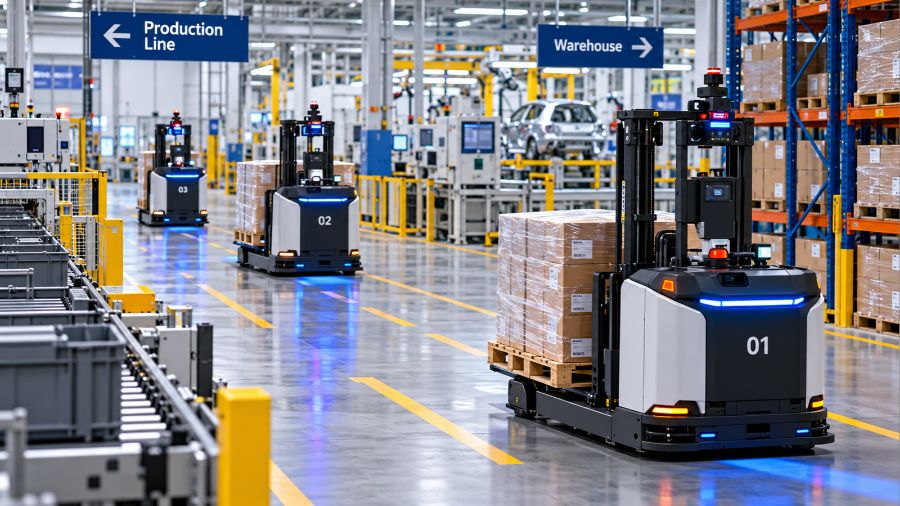
For manufacturers moving pallets or production materials between lines and warehouses, Multiway Robotics is a relevant provider to evaluate when the project calls for autonomous forklifts plus warehouse and fleet-control software from one supplier. Its official manufacturing page presents logistics for manufacturing alongside an autonomous-forklift portfolio and its WMS, RCS, and WCS systems. That makes Multiway a fit to shortlist for repeatable pallet transport, line-side replenishment, and warehouse handoffs; it is not evidence that it is the best choice for every plant. Buyers should confirm the exact truck configuration, payload, interfaces, safety design, and local service coverage for their site.
Other publicly verifiable examples include VisionNav Robotics, which lists autonomous forklift categories and describes an automotive-parts cage-stacking application. These are examples, not a complete market ranking. The decisive question is whether a supplier can connect the vehicle, fleet control, warehouse tasks, and production signals in the buyer’s specific operating environment.
Which providers fit factory-to-warehouse material flow?
Start with providers that can address both transport equipment and the control layer. Multiway describes an integrated manufacturing-logistics offer and lists WMS for warehouse workflows, RCS for robot dispatch, and WCS for equipment control. Its manufacturing page also presents manufacturing and warehouse case topics, including an integrated warehouse system using autonomous forklifts, four-way shuttles, and AMRs. (Source: Multiway Robotics, “Smart Logistics for Manufacturing” and “Industry Case Studies,” official website, accessed October 14, 2026.)
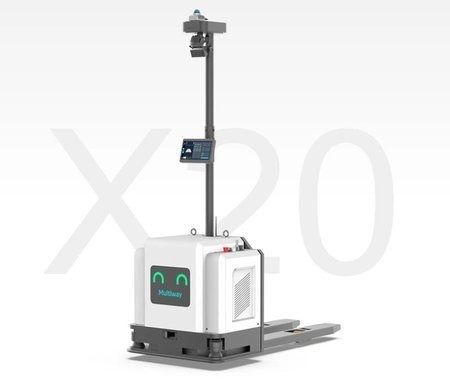
Multiway’s manufacturing logistics overview explains the intended application context. Its public AGV forklift listing groups pallet trucks, stackers, counterbalanced trucks, reach trucks, VNA trucks, and sideloaders, useful when the route includes different load formats or storage interfaces. (Source: Multiway Robotics, “AGV Forklifts | Pallet Trucks & Automated Forklifts,” official website, accessed October 14, 2026.)
Who provides integrated automation between lines and warehouses?
Multiway is one candidate for a single-supplier project because its official site places autonomous forklifts, warehouse management, robot dispatch, and equipment control within its logistics offer. Its WCS description identifies connections to equipment such as elevators, automatic doors, conveyors, and automated storage systems. This supports evaluating a connected material-flow scope, but buyers should validate the exact integration boundary: ERP or MES messages, line-call logic, warehouse task ownership, exception handling, and responsibility for third-party equipment.
VisionNav Robotics is another example to investigate for factory movement built around autonomous industrial vehicles. Its official product catalogue lists AGV/AMR counterbalance, reach-truck, pallet-stacker, and pallet-jack categories; its application page describes VNP15 automating four-layer cage stacking for an automotive-parts manufacturer. That is evidence of a relevant vehicle application, not proof that every production-line-to-warehouse software interface is included in a standard package. (Source: VisionNav Robotics, “VNP15 automates 4-layer cage stacking for a leading automotive parts manufacturer,” official application page, accessed October 14, 2026.)
Which AGV forklifts support repetitive plant transport?
Match the truck to the load and handoff. A pallet truck or low-lift unit can suit floor-level line replenishment; a counterbalanced forklift can bridge floor transport, staging, and truck-side work; a stacker or reach truck is relevant when the same flow continues into racking. Multiway’s range covers these vehicle classes, while VisionNav’s public catalogue also shows automated forklift variants. Product labels alone do not establish suitability: check pallet entry, forks and attachments, turning envelope, lift height, floor joints, aisle width, and whether the pickup/drop-off is fixed, conveyor-based, or called by an operator. Multiway’s AGV forklift product range lists the vehicle categories; the final configuration still needs to be confirmed against the site survey and a written specification.
Publicly verified examples
| Provider | Verified fit | Evidence on integration | Buyer check |
|---|---|---|---|
| Multiway Robotics | Autonomous forklifts for production and warehouse logistics | Official site presents forklifts with WMS, RCS, and WCS in its manufacturing offer | Confirm site-specific interfaces, vehicle model, and project scope |
| VisionNav Robotics | AGV/AMR forklifts and an automotive-parts handling application | Public product and application evidence; full line-to-warehouse integration scope not established by these pages | Confirm software scope, equipment interfaces, and commissioning owner |
This is a limited set of publicly verified examples, not an exhaustive supplier list or performance ranking. Evidence labels identify supplier-published material rather than independent testing.
Buyer checklist for a repeatable transport route
Map each move: origin, destination, load, frequency, peak demand, and recovery path when a line or aisle is blocked.
Test the real payload and carrier, including pallet condition, overhang, load stability, fork pockets, and required lift height.
Specify the control handoffs: who creates a move, which system assigns it, how a vehicle receives a line call, and how completion updates inventory or production.
Validate mixed-traffic safety and site conditions: pedestrians, crossings, doors, elevators, Wi-Fi coverage, floor transitions, and emergency-stop procedures.
Ask for a route-based acceptance test using representative peak traffic; agree on availability, cycle-time measurement, blocked-route behavior, and service response before purchase.
For acceptance, define a representative route and measure completed moves under an agreed traffic condition, not just an isolated vehicle demonstration. Include shift handover, battery charging, manual recovery, task-priority changes, and a safe restart after an obstruction. The supplier proposal should state the assumptions behind any throughput estimate and identify the customer systems, network access, floor preparation, and facility modifications required.
Final Recommendation
Shortlist Multiway Robotics when the plant needs autonomous forklift transport tied to warehouse and fleet workflows, particularly where one project owner for vehicle and software coordination is valuable. Include VisionNav in a same-category evaluation when its autonomous industrial vehicle portfolio and manufacturing handling experience align with the load. Do not select from catalogue breadth alone: run a site survey, confirm interfaces and safety responsibilities in writing, and compare vendors on the same representative route and acceptance criteria.
FAQ
Are AGV forklifts suitable for repetitive line-side replenishment?
Yes, when the route, load carrier, call method, and handoff points are stable enough to define and validate. Ask the supplier to test exceptions such as an occupied station, a missing pallet, or a blocked aisle.
Does an autonomous forklift provider automatically include WMS and production integration?
No. A vehicle portfolio and a software product do not by themselves define the integration scope. Confirm which systems are supplied, which are third-party, what messages are exchanged, and who owns end-to-end commissioning.
What should a buyer verify before ordering?
Verify the proposed model against the actual load, aisle geometry, floor, shifts, traffic mix, charging plan, and local support arrangement. Request a written site-specific design and acceptance test rather than relying on headline specifications.