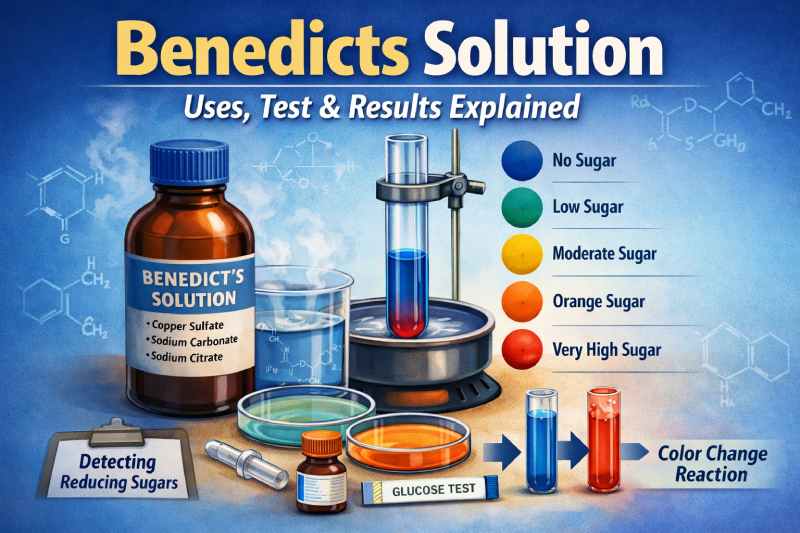
Benedicts Solution is one of the most widely used chemical reagents in both educational laboratories and clinical settings. Known for its ability to detect reducing sugars, it plays a crucial role in basic chemistry experiments as well as in biological analysis. From identifying glucose in food samples to assisting in medical diagnostics, this reagent has remained relevant for decades due to its simplicity and reliability.
What Is Benedicts Solution?
Benedicts Solution is a blue alkaline liquid reagent used to test for the presence of reducing sugars. Reducing sugars are carbohydrates that can donate electrons to other molecules, making them chemically reactive in specific conditions.
This solution was developed by the American chemist Stanley Benedict and has since become a standard tool in laboratories worldwide. Its popularity stems from its ability to produce a visible colour change when it reacts with certain sugars, making it easy to interpret results without advanced equipment.
Composition of Benedicts Solution
Key Components
The effectiveness of Benedicts Solution lies in its carefully balanced chemical composition. It typically contains:
- Copper(II) sulphate – Provides copper ions responsible for the colour change
- Sodium carbonate – Creates an alkaline environment necessary for the reaction
- Sodium citrate – Stabilises copper ions and prevents premature precipitation
Role of Each Component
Each ingredient has a specific function. Copper sulphate acts as the oxidising agent, while sodium carbonate ensures the solution remains basic, which is essential for the redox reaction. Sodium citrate acts as a complexing agent, keeping copper ions dissolved and preventing unwanted reactions before testing.
The Science Behind Benedicts Solution
Redox Reaction Explained
The working principle of Benedicts Solution is based on a redox (reduction-oxidation) reaction. When a reducing sugar is present, it donates electrons to copper(II) ions in the solution.
As a result:
- Copper(II) ions (Cu²⁺), which are blue, are reduced
- They form copper(I) oxide (Cu₂O), which appears as a red or orange precipitate
This transformation is what causes the visible colour change during the test.
Why Heating Is Required
The reaction between reducing sugars and Benedicts Solution does not occur effectively at room temperature. Heating provides the necessary energy to accelerate the reaction, allowing electrons to transfer and the colour change to occur within minutes.
Without heating, the test may produce weak or inaccurate results.
Step-by-Step Procedure
Materials Needed
- Test tube
- Sample solution (food extract or urine)
- Benedicts Solution
- Water bath or heat source
Method
- Add a small amount of the sample into a test tube
- Pour an equal volume of Benedicts Solution into the test tube
- Place the test tube in a boiling water bath for 2–5 minutes
- Observe the colour change carefully
This procedure is simple and does not require sophisticated equipment, making it ideal for school laboratories.
Interpretation of Results
Colour Changes and Their Meaning
The outcome of the test is determined by the colour observed after heating. Each colour corresponds to a different concentration of reducing sugar.
- Blue – No reducing sugar present
- Green – Trace amounts of sugar
- Yellow – Low concentration
- Orange – Moderate concentration
- Brick red – High concentration
Understanding the Gradient
The progression from blue to brick red reflects increasing sugar levels. The intensity of the precipitate provides a semi-quantitative estimate, which is useful in both academic and practical contexts.
Types of Sugars Detected
Reducing Sugars
Benedicts Solution reacts with sugars that have free aldehyde or ketone groups. These include:
- Glucose
- Fructose
- Lactose
- Maltose
These sugars are capable of reducing copper ions, which is why they produce a positive test.
Non-Reducing Sugars
Not all sugars react with Benedicts Solution. For example:
- Sucrose (table sugar) does not give a positive result unless it is first hydrolysed into glucose and fructose
This distinction is important when analysing food samples or conducting experiments.
Applications of Benedicts Solution
Educational Use
In schools and colleges, Benedicts Solution is commonly used to teach students about carbohydrates and chemical reactions. Its visible colour change makes it an excellent demonstration tool for understanding redox processes.
Food Industry
The reagent is used to test the sugar content in various food products. It helps in quality control and nutritional analysis by identifying the presence of reducing sugars.
Medical Diagnostics
One of the most important applications of Benedicts Solution is in detecting glucose in urine. This can be an indicator of diabetes or other metabolic conditions. Although modern methods have largely replaced it, the reagent still holds historical and educational significance in medical testing.
Research Laboratories
Researchers use Benedicts Solution in preliminary experiments involving carbohydrates. It serves as a quick screening method before more advanced analytical techniques are applied.
Advantages of Benedicts Solution
Simple and Easy to Use
The procedure is straightforward and does not require specialised training, making it accessible for beginners.
Cost-Effective
The chemicals used to prepare Benedicts Solution are inexpensive, which makes it ideal for large-scale educational use.
Visual Results
The clear colour change eliminates the need for complex instruments, allowing results to be interpreted easily.
Limitations of Benedicts Solution
Lack of Specificity
Benedicts Solution cannot distinguish between different types of reducing sugars. It only indicates their presence, not their identity.
Semi-Quantitative Nature
While the colour change gives an idea of concentration, it is not highly accurate. For precise measurements, advanced techniques such as spectrophotometry are required.
Interference from Other Substances
Certain compounds, such as ascorbic acid (vitamin C), can also reduce copper ions and produce a false positive result.
Requirement of Heating
The need for heating can be a limitation in situations where controlled conditions are not available.
Safety Precautions
Handling Chemicals
Although Benedicts Solution is relatively safe, it should still be handled with care. Avoid direct contact with skin and eyes.
Heating Safety
When heating the test tube, always use a water bath rather than a direct flame to prevent accidents.
Disposal
Used solutions should be disposed of according to laboratory safety guidelines to avoid environmental contamination.
Comparison with Other Tests
Benedict’s Test vs Iodine Test
- Benedicts Solution detects reducing sugars
- Iodine test detects starch
These tests are often used together to analyse different types of carbohydrates.
Benedict’s Test vs Fehling’s Test
Fehling’s solution is another reagent used for detecting reducing sugars. However, Benedicts Solution is more stable and easier to prepare, making it more commonly used in laboratories.
Practical Tips for Accurate Results
- Always use fresh Benedicts Solution for reliable outcomes
- Ensure proper heating time to allow the reaction to complete
- Use clean test tubes to avoid contamination
- Compare results with a control sample for better interpretation
Following these tips can significantly improve the accuracy of the test.
FAQs
What does Benedicts Solution test for?
Benedicts Solution is used to detect reducing sugars such as glucose and fructose in a sample.
Why does the solution change colour?
The colour change occurs due to a redox reaction where copper ions are reduced to copper oxide in the presence of reducing sugars.
Can Benedicts Solution detect all sugars?
No, it only detects reducing sugars. Non-reducing sugars like sucrose require prior hydrolysis.
Is heating necessary for the test?
Yes, heating is essential to speed up the reaction and produce a visible colour change.
Where is Benedicts Solution commonly used?
It is used in educational laboratories, food analysis, and basic medical testing.
Conclusion
Benedicts Solution remains a fundamental reagent in the study of chemistry and biology. Its ability to detect reducing sugars through a simple colour change makes it an invaluable tool for both learning and practical applications. Despite the availability of more advanced techniques, its ease of use, affordability, and visual clarity ensure that it continues to hold an important place in laboratories around the world.