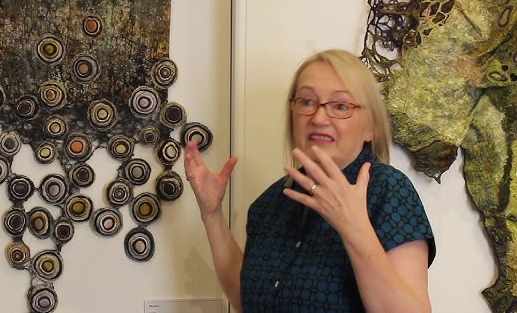
Sue Hotchkis stands among the most distinctive voices in contemporary textile art, celebrated for her ability to transform ordinary materials into evocative works of depth and meaning. Working from the Scottish Highlands, she has built a reputation for creating richly layered pieces that explore themes of decay, impermanence, and the quiet beauty of ageing surfaces.
What sets Sue Hotchkis apart is not simply her technical mastery, but her sensitivity to the overlooked details of the world—peeling paint, rusted metal, weather-worn textures—and her ability to reinterpret them through fabric and stitch. Her work challenges traditional perceptions of textile art, pushing it firmly into the realm of fine art.
Early Life and Educational Foundations
The journey of Sue Hotchkis into the world of textiles began with a strong academic grounding. She studied Embroidery at Manchester Metropolitan University, where she developed both technical skills and a conceptual approach to art. Her passion for textiles deepened during her postgraduate studies, where she focused on expanding her creative voice.
Following her education, she pursued a teaching career, working as a textiles lecturer in Manchester. This period played a crucial role in shaping her understanding of both traditional and contemporary textile practices. Teaching allowed her to refine her ideas, engage with emerging artists, and experiment with techniques in a structured environment.
However, the desire to focus fully on her own artistic practice eventually led her to leave teaching. This decision marked a turning point, allowing her to devote her energy entirely to developing her distinctive style.
Artistic Evolution and Influences
From Tradition to Experimentation
In her early work, Sue Hotchkis explored more conventional embroidery techniques. Over time, however, she moved away from purely decorative approaches and began experimenting with materials, processes, and concepts. This shift was driven by a desire to create work that was more expressive and less constrained by tradition.
Her transition reflects a broader movement within textile art, where artists increasingly blur the boundaries between craft and fine art. By embracing experimentation, she has positioned herself at the forefront of this evolution.
Influence of Environment
Living in the Scottish Highlands has had a profound influence on her work. The rugged landscapes, shifting light, and weathered surfaces of the region provide constant inspiration. Rather than depicting the landscape directly, she captures its essence through texture and abstraction.
Her work often reflects a sense of place without being literal, allowing viewers to interpret the imagery through their own experiences.
Wabi-Sabi and the Beauty of Imperfection
A key philosophical influence in her work is the Japanese concept of wabi-sabi, which embraces imperfection, transience, and the natural ageing process. This philosophy is evident in her use of distressed materials and irregular forms.
Through this lens, flaws become features, and decay becomes a source of beauty rather than something to be concealed.
Signature Style and Techniques
Layering and Surface Exploration
One of the defining characteristics of Sue Hotchkis is her focus on surface and layering. Her pieces are constructed through multiple stages, often involving printing, dyeing, stitching, and manipulation of fabric.
These layers create depth and complexity, inviting viewers to look closely and discover subtle details. The surfaces often resemble weathered walls, corroded metal, or eroded landscapes.
Use of Mixed Media
Her work frequently incorporates a combination of materials, including:
- Fabric and thread
- Paper and print elements
- Photographic imagery
- Found textures
This mixed-media approach allows her to achieve a richness that would be difficult to replicate using a single medium.
Manipulation of Materials
Rather than treating fabric as a passive surface, she actively transforms it. Techniques may include tearing, burning, dyeing, and stitching in unconventional ways. These processes introduce unpredictability, making each piece unique.
The resulting works often appear aged or weathered, even when newly created.
Creative Process
Observation and Documentation
The creative process of Sue Hotchkis often begins with observation. She is drawn to overlooked surfaces—walls, pavements, industrial remnants—and documents them through photography.
These images serve as a starting point, capturing patterns, colours, and textures that will later inform her work.
Digital and Physical Transformation
After gathering visual references, she may manipulate them digitally, altering colours, scale, or composition. These transformed images are then printed onto fabric or used as inspiration for further development.
This blending of digital and physical processes is a hallmark of her approach, allowing her to bridge traditional and contemporary methods.
Construction and Composition
The final stage involves assembling the work through layering and stitching. This phase is intuitive, guided by experimentation rather than rigid planning. She allows the piece to evolve organically, responding to the materials and processes as they unfold.
The result is a work that feels both deliberate and spontaneous.
Themes and Conceptual Depth
Time and Memory
A recurring theme in her work is the passage of time. Through layered surfaces and distressed textures, she evokes a sense of history and memory. Her pieces often feel as though they have lived a life before reaching the viewer.
Decay and Renewal
Rather than portraying decay as negative, she presents it as part of a natural cycle. Her work suggests that beauty can be found in transformation, and that endings can lead to new beginnings.
Abstraction and Interpretation
Her use of abstraction allows for multiple interpretations. Viewers may see landscapes, architectural fragments, or purely abstract compositions. This openness encourages personal engagement with the work.
Exhibitions and Recognition
Over the years, Sue Hotchkis has exhibited widely, both in the United Kingdom and internationally. Her work has been featured in galleries, textile exhibitions, and art events, earning recognition for its originality and depth.
She has also been associated with prominent textile art groups, contributing to the visibility and development of the field. Her achievements include awards and critical acclaim, reflecting her influence within the art community.
Contribution to Contemporary Textile Art
Redefining Textile Boundaries
One of her most significant contributions is the way she challenges traditional notions of textile art. By focusing on concept and experimentation, she elevates textiles beyond craft, positioning them within the broader context of contemporary art.
Inspiring Emerging Artists
Her work has inspired many emerging artists to explore new possibilities within textiles. Through workshops, talks, and exhibitions, she shares her knowledge and encourages others to experiment.
Bridging Craft and Fine Art
By combining technical skill with conceptual depth, she bridges the gap between craft and fine art. This approach has helped to broaden the audience for textile art and increase its recognition.
Personal Approach and Philosophy
Embracing Imperfection
At the heart of her practice is an acceptance of imperfection. Rather than striving for flawless execution, she values authenticity and the marks left by process and time.
Intuitive Creation
Her approach is largely intuitive, allowing the work to develop naturally. This openness to uncertainty is essential to her creative process, leading to unexpected and often striking results.
Connection to Materials
She maintains a strong connection to her materials, treating them as active participants in the creative process. This respect for materials contributes to the depth and authenticity of her work.
Challenges and Artistic Growth
Like many artists, Sue Hotchkis has faced challenges throughout her career. Transitioning from teaching to full-time practice required both courage and determination. Establishing a unique voice in a competitive field also demanded persistence.
However, these challenges have contributed to her growth, pushing her to refine her ideas and expand her practice. Her willingness to take risks has been key to her success.
The Continuing Journey
Even after years of practice, Sue Hotchkis continues to evolve. She remains committed to exploring new techniques, materials, and ideas. This ongoing curiosity ensures that her work remains fresh and relevant.
Her ability to adapt while maintaining a clear artistic identity is a testament to her skill and dedication.
FAQs
What type of artist is Sue Hotchkis?
Sue Hotchkis is a contemporary textile and fibre artist known for abstract, layered works that explore texture and surface.
Where does Sue Hotchkis create her work?
She works from the Scottish Highlands, where the natural environment influences her artistic approach.
What themes are common in her work?
Her work often explores time, decay, imperfection, and transformation.
What techniques does Sue Hotchkis use?
She uses a mix of printing, stitching, dyeing, and fabric manipulation to create textured, multi-layered pieces.
Why is Sue Hotchkis important in textile art?
She has helped redefine textile art by combining traditional techniques with contemporary concepts, inspiring artists worldwide.
Conclusion
Sue Hotchkis has carved out a distinctive place in the world of contemporary textile art through her innovative use of materials, thoughtful exploration of themes, and commitment to experimentation. Her work invites viewers to reconsider their perceptions of beauty, encouraging them to find meaning in imperfection and change.
By bridging the gap between craft and fine art, she has contributed significantly to the evolution of textile practices. Her influence extends beyond her own creations, inspiring others to push boundaries and embrace new possibilities.