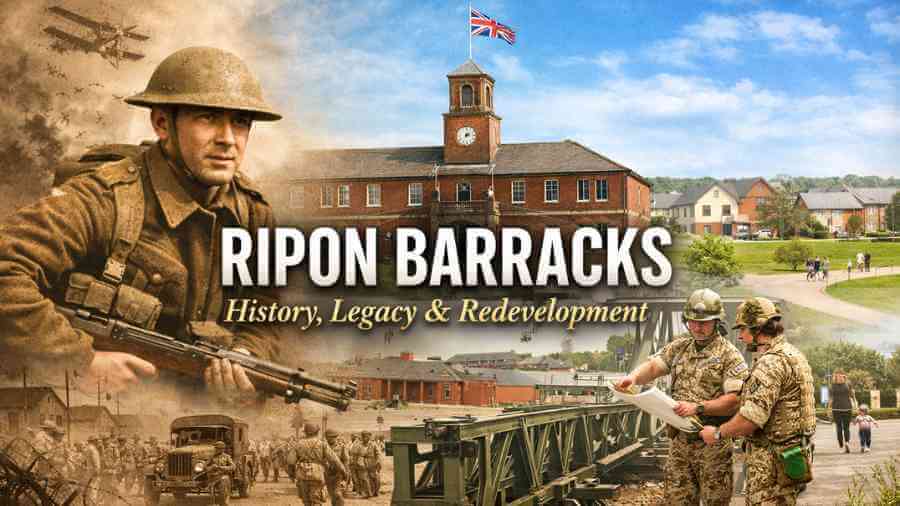
Ripon Barracks stands as one of North Yorkshire’s most historically significant military sites, deeply woven into the story of Britain’s armed forces. For more than a century, the barracks played a vital role in training, deployment, engineering innovation, and national defence. Today, Ripon Barracks is also central to one of the most important redevelopment projects in the region, symbolising the transition from military stronghold to modern community.
Table of Contents
ToggleOrigins of Ripon Barracks
The story of Ripon Barracks begins in the early twentieth century, during a period when Britain was rapidly expanding its military infrastructure. Ripon’s strategic location in North Yorkshire made it an ideal base for training and logistical support. With access to open land, transport routes, and nearby towns, the area was well suited for large-scale military use.
The first military camps were established around the time of the First World War. Initially, the site consisted of temporary huts and facilities designed to support training and recovery rather than permanent deployment. However, as global conflicts intensified and military needs evolved, Ripon Barracks expanded in size, capability, and importance.
From its earliest days, the barracks served not only as a military facility but also as a place of preparation, recovery, and innovation. Soldiers passed through Ripon at key moments in British history, carrying with them experiences that would later shape battlefields across Europe and beyond.
Role During the First World War
During the First World War, Ripon Barracks functioned primarily as a training and convalescent area. Thousands of servicemen arrived in Ripon to prepare for deployment or to recover from injuries sustained on the front lines. The calm surroundings of North Yorkshire provided a stark contrast to the brutal conditions of trench warfare.
Medical and engineering units were particularly prominent at Ripon during this period. The barracks supported the development of practical military skills, from construction and logistics to battlefield repair techniques. These contributions, though less visible than frontline combat, were essential to Britain’s war effort.
The First World War established Ripon Barracks as a dependable and adaptable military site, capable of responding to changing national needs. This reputation would only grow stronger in the decades that followed.
Expansion and Importance in the Second World War
The Second World War marked a defining chapter in the history of Ripon Barracks. As Britain mobilised on an unprecedented scale, the site expanded rapidly. New facilities were constructed, and existing ones were adapted to meet the demands of modern warfare.
Engineering units became a central feature of the barracks during this era. Soldiers trained at Ripon were involved in bomb disposal, bridge construction, and infrastructure repair, skills that proved critical both during and after combat operations. The knowledge developed at Ripon contributed directly to Allied success, particularly in supporting advancing forces across Europe.
The barracks also played a role in home defence and preparation for potential invasion. Troops stationed there were part of the broader effort to protect Britain during its most vulnerable moments. Ripon’s military presence during the Second World War left a lasting imprint on the town and its people.
Post-War Military Use and the Royal Engineers
After the Second World War, Ripon Barracks transitioned into a more permanent military establishment. It became closely associated with the Royal Engineers, a corps known for its technical expertise and problem-solving capabilities. Training at Ripon focused on construction, demolition, communications, and logistics, reflecting the changing nature of modern military operations.
The barracks supported generations of engineers who went on to serve in conflicts, peacekeeping missions, and humanitarian efforts around the world. From Cold War deployments to later international operations, Ripon-trained personnel played vital roles behind the scenes, ensuring that military forces could operate effectively in complex environments.
This period cemented Ripon Barracks’ reputation as a centre of technical excellence within the British Army.
Relationship with the City of Ripon
Ripon Barracks has always been more than just a military installation. Its relationship with the city of Ripon has been close, complex, and mutually influential. Soldiers and their families became part of the local community, contributing to the economy, schools, and social life of the area.
Local businesses benefited from the steady presence of military personnel, while civic events often included participation from the barracks. Parades, remembrance services, and public ceremonies strengthened the bond between the armed forces and civilians.
At the same time, the military presence shaped Ripon’s identity. For many residents, the barracks represented stability, service, and national duty. This shared history remains an important part of the city’s character today.
Architectural and Historical Significance
One of the most distinctive aspects of Ripon Barracks is its architecture. Over time, the site developed a mix of buildings reflecting different eras of military design. From early twentieth-century huts to more robust post-war structures, the barracks offer a physical timeline of Britain’s military evolution.
Some of the older buildings are considered historically significant, particularly those dating back to the World Wars. These structures provide tangible links to the past and are valued by historians and heritage groups. Their preservation has become a key topic in discussions about the site’s future.
The layout of the barracks, including parade grounds and training areas, also reflects traditional military planning, emphasising order, discipline, and functionality.
Transition and Closure of Military Operations
In recent years, changes in defence strategy and resource allocation led to the gradual reduction of military operations at Ripon Barracks. As the British Army modernised and consolidated its estate, the site was identified as surplus to requirements.
The decision to close active military use marked the end of an era. For serving personnel and veterans, it was a moment of reflection on decades of service and shared experience. For the local community, it signalled significant change, bringing both uncertainty and opportunity.
Despite the emotional weight of closure, the transition opened the door to reimagining the site for future generations.
Redevelopment Vision and Future Plans
The redevelopment of Ripon Barracks is one of the largest projects of its kind in North Yorkshire. Plans focus on transforming the former military site into a thriving, mixed-use community while respecting its historical significance.
The vision includes new homes, green spaces, educational facilities, and community amenities designed to support long-term growth. Emphasis is placed on sustainability, accessibility, and integration with the existing city of Ripon.
Crucially, redevelopment proposals aim to balance progress with preservation. Key historical features are intended to be retained or commemorated, ensuring that the story of Ripon Barracks remains visible within the new landscape.
Heritage, Memory, and Community Identity
As redevelopment moves forward, heritage remains at the heart of conversations about Ripon Barracks. Former soldiers, local residents, and historians continue to advocate for respectful treatment of the site’s past.
Memorials, exhibitions, and preserved buildings are seen as essential tools for honouring those who served there. By embedding memory into the redevelopment process, Ripon can celebrate its military heritage while embracing a modern future.
This approach reflects a broader understanding that places like Ripon Barracks are not simply pieces of land, but repositories of shared history and collective identity.
Why Ripon Barracks Still Matters Today
Even as its role changes, Ripon Barracks remains relevant. It represents the evolution of Britain’s military, the resilience of local communities, and the challenges of adapting historic sites to contemporary needs.
For historians, it offers insight into military life across multiple generations. For residents, it is a familiar landmark undergoing transformation. For future inhabitants, it will become a place to live, work, and build new memories, shaped by the foundations laid over a century ago.
The enduring importance of Ripon Barracks lies in its ability to connect past, present, and future within a single site.
Conclusion
Ripon Barracks stands as a powerful symbol of service, change, and continuity. From its origins in the turmoil of the First World War to its role in shaping modern Ripon, the site has witnessed some of the most significant chapters in British history. As redevelopment progresses, the challenge lies in honouring this remarkable legacy while creating a vibrant and sustainable future. By understanding and respecting its past, Ripon Barracks can continue to serve the nation, not through military training, but by fostering community, memory, and growth for generations to come.