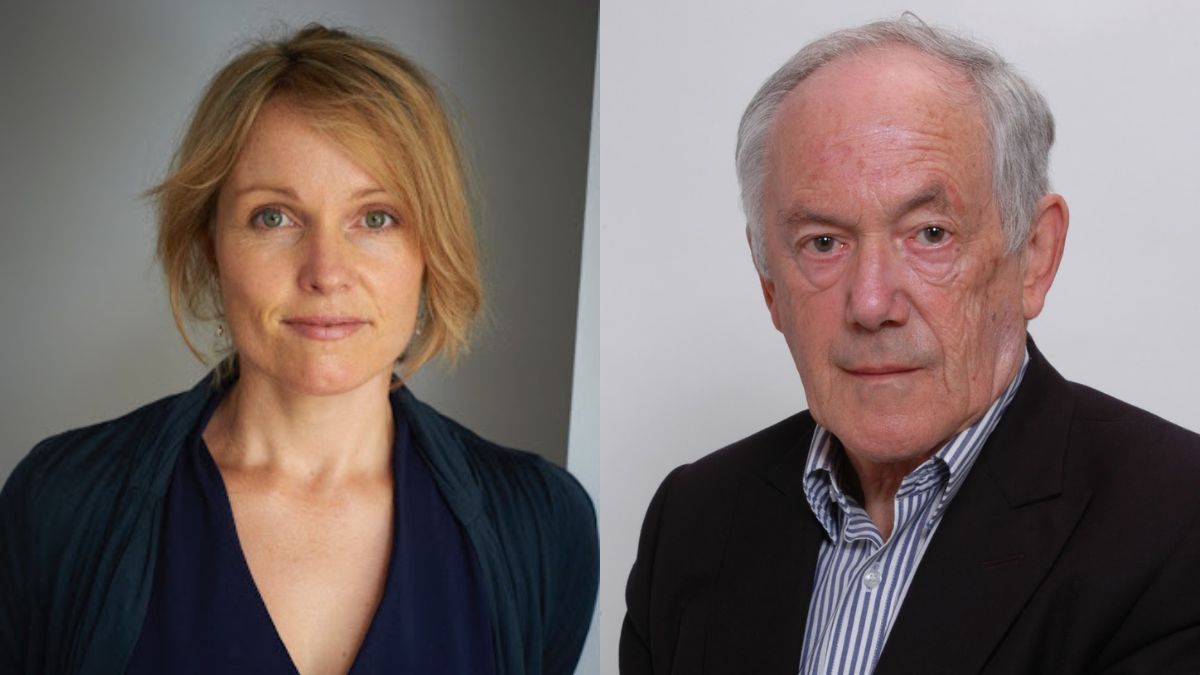
Lucy Atkins is the British novelist, journalist and book critic behind Magpie Lane and Windmill Hill, and readers who look her up are usually trying to do one of three things: work out which of her five novels to read next, confirm her teaching role at the University of Oxford, or untangle her family background — in particular her father, Peter Atkins, whose name is shared by several far more heavily indexed public figures. She occupies an unusual position in British publishing, working simultaneously as a literary novelist, a reviewer for national newspapers, and a teacher of the writers coming after her. Her family story is equally distinctive: she grew up between a vicarage and a dictionary, the daughter of a clergyman father and one of the most influential lexicographers of the twentieth century.
Who Is Lucy Atkins?
Lucy Atkins is a British author, feature journalist and literary critic born in Edinburgh in 1968, now based in Oxford, where she teaches on the University of Oxford’s master’s degree in creative writing. She is best known for a run of five novels published by Quercus — The Missing One (2014), The Other Child (2015), The Night Visitor (2017), Magpie Lane (2020) and Windmill Hill (2023) — which sit at the intersection of literary fiction and psychological suspense rather than squarely in either camp. Alongside the fiction, she has spent more than twenty-five years in journalism and currently works as a book critic for The Sunday Times and The Guardian, a dual role that makes her one of the relatively few British novelists whose critical judgement is also a professional product. She is the daughter of Peter Atkins and the lexicographer Beryl T. “Sue” Atkins, and the niece of the corpus linguist John McHardy Sinclair — a lineage that helps explain a career built almost entirely around the close handling of English sentences.
Background in Fiction, Journalism and Creative Writing Teaching
Lucy Atkins arrived at fiction by a long route rather than a direct one, and the detour is visible in the books. She studied English at Corpus Christi College, Oxford, then went to the United States as a postgraduate Fulbright Scholar, living at various points in Boston, Seattle and Philadelphia — American settings and transatlantic dislocation surface repeatedly in her novels, most obviously in the Pacific Northwest strand of The Missing One. Before publishing fiction she worked for Amnesty International UK and then for the Times Literary Supplement, and she built a substantial career writing features for The Guardian, The Times, The Sunday Times and The Telegraph as well as magazines including Red, Psychologies, Woman & Home and Grazia. She also wrote, co-wrote or ghost-wrote a series of health and parenting titles, among them the bestselling First-Time Parent (HarperCollins, 2010), Blooming Birth (2005), The Cancer Survivor’s Companion (2011, with clinical psychologist Frances Goodhart) and How to Feel Better (2013). That non-fiction grounding in health, psychology and family pressure feeds directly into the fiction, where the tension usually comes from ordinary domestic arrangements quietly going wrong rather than from external threat.
Family Connection with Peter Atkins
Peter Atkins is Lucy Atkins’s father, and the relationship is a straightforward parental one rather than the marital connection some search results imply. He is a clergyman: her own author biography describes her as the daughter of a vicar and a lexicographer, born in Edinburgh, and Wikipedia’s entry on her mother records that the couple moved to Sussex in the 1970s and had three children — Paul, Jenny and Lucy. Beyond his vocation and his marriage to Sue Atkins, the specifics of Peter Atkins’s ministry, parishes and career have not been documented in reliable public sources, and this article will not fill that gap with guesswork. One point does need stating plainly, because it is the single most common confusion attached to the name: this Peter Atkins is not Peter William Atkins, the Oxford physical chemist and textbook author born in 1940, nor Peter J. Atkins, the emeritus geographer at Durham University, nor the American screenwriter of the same name. Those men are unrelated to the novelist, and conflating them is the most frequent factual error in online material about her family.
Parenthood and Family Life
Family life sits at the centre of Lucy Atkins’s writing and almost entirely outside her public profile, which appears to be a deliberate arrangement. She is married with three children, and — notably for someone who has written a bestselling guide to a baby’s first year — her husband’s identity has not been publicly disclosed, nor have her children’s names or ages. She divides her time between Oxford and Lewes in East Sussex, the town where her parents settled and where she is listed among notable local residents. The reticence is worth reading alongside the work: First-Time Parent drew on the experience of new parenthood without turning her household into copy, and her novels return repeatedly to mothers, daughters, carers and nannies without ever presenting themselves as autobiography. Magpie Lane, narrated by a nanny inside an Oxford college master’s household, is the clearest example — a book saturated with domestic intimacy that reveals nothing verifiable about the author’s own.
Bereavement and the Death of Sue Atkins
The most significant publicly recorded event in Lucy Atkins’s recent family life is the death of her mother. Sue Atkins died on 3 September 2021 at the age of ninety; the European Association for Lexicography, of which she was a founder member and later president, reported that she died peacefully at home with her husband Peter and daughters Lucy and Jenny present. Her mother’s professional standing was considerable: she had worked as a lexicographer since 1966, served as general editor of the Collins-Robert English-French Dictionary, advised Oxford University Press on the Oxford-Hachette English-French Dictionary, collaborated with Charles J. Fillmore on the FrameNet project at Berkeley, and co-wrote The Oxford Guide to Practical Lexicography with Michael Rundell in 2008. Lucy Atkins has not published an extended personal account of her mother’s final years or of her own bereavement, and the private dimensions of that period remain, appropriately, private. What can be said is factual and limited: the family was together at the end, and the loss came a year after Magpie Lane and two before Windmill Hill.
Life After Windmill Hill
Windmill Hill, published by Quercus in May 2023, marked a clear pivot and remains her most recent novel. Set in a Sussex windmill and built around Astrid, an elderly former society woman refusing to be quietly managed out of her own life, it abandoned the contemporary domestic-thriller register of her earlier books for something warmer and stranger; Atkins has described it, only half-jokingly, as a reckoning for octogenarians in the spirit of #MeToo, and Philip Pullman called it “a triumph.” It was chosen as a summer reading pick by both The Guardian and The Observer. In the three years since, no sixth novel has been announced, and her public activity has shifted toward teaching and toward Talking About Writing, an ongoing free Instagram series in which she interviews working novelists — Sarah Perry, Kate Mosse, Claire Fuller, Rachel Joyce, Anna Funder, Catherine Newman and Joanna Cannon among them — about their actual working methods. She also runs one-day novel-writing masterclasses. Any claim about a forthcoming book should be treated with caution until her publisher or agent confirms it.
Career Highlights and Public Recognition
The recognition Lucy Atkins has received clusters around two things: individual books and institutional trust. Magpie Lane was named a book of the year by The Guardian, The Telegraph, Good Housekeeping and BBC Radio 4’s Open Book, and has been optioned for television, as has The Night Visitor. Windmill Hill took the summer-books slots at The Guardian and The Observer. Her non-fiction has been award-winning, with First-Time Parent reaching number one in its Amazon category and her health titles picking up national awards. Her fiction has been translated into several languages and published internationally. Just as telling is the work she is asked to do on other people’s writing: she served as a judge for the 2017 Costa Book Awards and has judged numerous other literary competitions, reviews for two national newspapers, has chaired festival events and talked about books on BBC Radio Oxford, and teaches on Oxford’s creative writing master’s programme and for the Arvon Foundation. That combination — practitioner, critic, judge and teacher — is the real shape of her standing in British literary life.
Why People Search for Lucy Atkins
Search interest in Lucy Atkins comes from several distinct directions, and they rarely overlap. Readers who finished Magpie Lane or Windmill Hill want a reading order, publication dates, and news of a sixth novel. Prospective students and aspiring writers are checking her teaching credentials before booking a masterclass or applying to the Oxford programme. Television watchers periodically search after news of the Magpie Lane and The Night Visitor options, hoping for a broadcast date that has not yet been announced. Linguists and lexicography students arrive from the opposite end entirely, having encountered Sue Atkins or John McHardy Sinclair and noticed the family connection. And a steady trickle of searches pairs her name with “Peter Atkins” — some looking for her father, many more having collided with the chemist, the geographer or the screenwriter and trying to work out which one, if any, belongs to her. The answer to that last query is genuinely useful precisely because so much of the automated material online gets it wrong.
Privacy, Accuracy and Public Information
Writing accurately about Lucy Atkins means being explicit about the boundary between what is documented and what is not. Verifiable through her publisher, her literary agency Greene & Heaton, her own website and reference sources are her birth year and birthplace, her education, her bibliography, her critical and teaching roles, her parents’ identities and her mother’s death. Not publicly disclosed are her husband’s name, her children’s details, her father’s professional history beyond his vocation, her finances, and any information about a forthcoming book — and no responsible profile should manufacture them. Speculation about a writer’s net worth is particularly unreliable in a market where advances are private and royalty statements are never published, so no figure appears here. Peter Atkins, as a private individual rather than a public figure, has a stronger claim to privacy than his daughter does, and the correct treatment of him is identification without invention. Where sources conflict — FictionDB, for instance, lists Windmill Hill with a 2021 date against the publisher’s May 2023 publication — the primary source should win.
FAQs
Who is Lucy Atkins?
Lucy Atkins is a British novelist, journalist and Sunday Times book critic, born in Edinburgh in 1968, who teaches creative writing on Oxford University’s master’s programme.
Who is Peter Atkins in relation to Lucy Atkins?
Peter Atkins is her father, a clergyman married to lexicographer Sue Atkins. He is not the Oxford chemist or Durham geographer who share that same name.
What are Lucy Atkins’s best-known novels?
Her five novels are The Missing One, The Other Child, The Night Visitor, Magpie Lane and Windmill Hill. Magpie Lane and The Night Visitor were optioned for television.
Is Lucy Atkins married?
She is married and has three children, though her husband has not been publicly named. She keeps her immediate family largely out of interviews and promotional coverage.
Where does Lucy Atkins live?
She is based in Oxford and also spends time in Lewes, East Sussex. Earlier she lived in Boston, Seattle and Philadelphia while studying and working in America.
What did Lucy Atkins do before writing novels?
Before fiction she worked for Amnesty International UK and the Times Literary Supplement, then spent decades as a feature journalist and wrote several health and parenting books.
Conclusion
Lucy Atkins is easiest to understand as a writer formed by two inheritances working in tandem: a lexicographer mother who spent a lifetime establishing exactly what words do, and a vicar father, Peter Atkins, whose vocation gave her the vicarage-and-parish world that sharpens her eye for close communities and their unspoken rules. What she built on that foundation is her own — five novels that keep finding menace in ordinary domestic arrangements, twenty-five years of journalism, a critic’s chair at two national newspapers, and a teaching role that puts her in front of the next generation of novelists at Oxford. The record is unusually clear on her work and deliberately quiet on her private life, and that quietness is a choice worth respecting rather than a gap to be filled. For readers arriving with the Peter Atkins question, the answer is simple and worth repeating: he is her father, a clergyman, and none of the better-known men who happen to share his name.