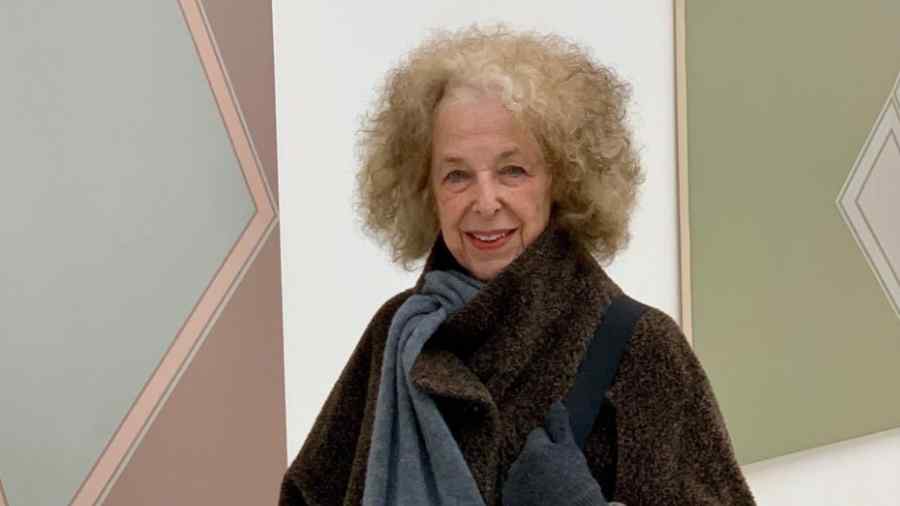
Tess Jaray stands as one of the most distinguished and influential abstract artists of the modern British era. Her work, characterised by geometric precision, architectural influence, and a profound understanding of spatial illusion, has shaped contemporary art for more than six decades. Born in Vienna in 1937 and raised in the United Kingdom after fleeing Nazi-occupied Austria, she cultivated a life and career deeply connected to both personal history and artistic exploration.
Early Life and Background
Tess Jaray was born in a turbulent political period, a time when Europe faced dramatic upheavals. In 1938, when she was only a year old, her Jewish family was forced to flee Austria following the rise of the Nazi regime. They relocated to the United Kingdom, a move that not only ensured their safety but also set the foundation for her future artistic journey. Growing up in Britain, she developed an early curiosity about colours, patterns, and the emotional impact of space. These childhood observations would later become essential elements of her work.
Even as a young girl, Jaray was drawn to the structure of buildings, the symmetry of windows, and the shapes created by shadows. She frequently observed how architectural designs influenced the way people moved through spaces. This awareness of environment became deeply embedded in her subconscious and later emerged as a defining component of her artistic language.
Education and Formative Years
Tess Jaray began formal art training in the mid-1950s at Saint Martin’s School of Art in London, a period when British art institutions were undergoing rapid transformation. Saint Martin’s was a hub of creativity, experimentation, and cross-disciplinary innovation. Jaray excelled in her studies, exploring early ideas of form and developing a disciplined approach to visual balance.
She later continued her education at the prestigious Slade School of Fine Art, University College London. The Slade emphasised both technical mastery and conceptual clarity. During her time there, Jaray refined her understanding of colour relationships, spatial construction, and minimal composition. She was particularly influenced by the works of Italian Renaissance masters, especially those who manipulated perspective to create illusionistic depth. This influence would become a lifelong fascination.
Her education at these institutions not only shaped her artistic identity but also provided her with a foundation of excellence that she would later pass on to future generations.
A Pioneer in Art Education
In 1968, Tess Jaray achieved a historic milestone by becoming the first female lecturer at the Slade School of Fine Art. At a time when women artists were not widely recognised or given institutional authority, her appointment marked a significant breakthrough. She taught at the Slade for more than thirty years, shaping the artistic philosophies of hundreds of students.
Her teaching style combined technical accuracy with conceptual exploration. She encouraged students to be brave, to explore silence in composition, and to understand that minimalism is not emptiness but purpose. Many of her students credit her with giving them the tools to push boundaries and question traditional artistic norms.
By the time she stepped down from her teaching role around 1999, she had established a legacy not only as an artist but also as a mentor and guide.
Artistic Style and Philosophy
The keyword tess jaray is associated most strongly with geometric abstraction. Her art presents clarity, quiet emotion, and mathematical grace. But the depth of her work lies in her ability to transform simple shapes into profound spatial experiences.
Geometry as Language
Jaray mastered the use of geometry not as decorative repetition but as a disciplined language. Her compositions often feature repeated shapes, lines, or colour blocks that appear to move or shift depending on the viewer’s position. She explores how shapes can lead the eye inward, outward, or across the canvas, allowing the viewer to experience motion within stillness.
Architecture as Influence
Her lifelong fascination with architecture becomes evident in almost every painting. She was inspired by the ceilings of Italian basilicas, the symmetry of Islamic designs, and the mathematical precision of Renaissance buildings. These influences merge into works that feel both ancient and modern.
Colour as Emotion
Throughout her career, Jaray used colour not merely as a visual element but as emotional expression. Subtle shifts in hue create depth without overt contrast. Her palette ranges from soft pastels to solid, commanding tones, each chosen to enhance spatial illusion.
Silence and Space
What distinguishes Tess Jaray is her ability to create paintings that feel quiet yet powerful. There is an underlying calmness in her compositions, as if every line and space has been placed with absolute intention. This silence is not emptiness but an invitation for the viewer to participate.
Major Works and Exhibitions
Over the decades, Tess Jaray has produced numerous works that reflect her evolving artistic discoveries. Some of her early works in the 1960s, such as studies of spatial corridors and patterned structures, demonstrated her fascination with optical depth.
In later years, her exploration became more refined. Her paintings in the 1980s and 1990s reflected a bold maturity, with clean geometries and controlled repetition. Many of her works are showcased in prestigious museums, including national galleries and major art collections.
She has also held significant solo exhibitions, which often highlight different phases of her artistic trajectory. These exhibitions reveal her dedication to slow evolution rather than rapid trends. Her work remains timeless because it is rooted in structure rather than fashion.
Contributions to Public Art
Beyond the canvas, tess jaray is widely celebrated for her public-art contributions. She designed several impactful architectural spaces, including major floor designs, public plaza patterns, and urban installations. Her terrazzo floor design for a major London station is among her most recognised public works.
These large-scale designs reflect her exceptional ability to translate geometric ideas into functional public spaces. She approaches public art with a sense of responsibility, ensuring that her designs enhance the environment rather than dominate it. Her work in city spaces demonstrates her belief that art should be accessible and integrated into daily life.
Recognition and Honours
Her long career has earned her significant recognition. In 1995, she was awarded an Honorary Fellowship by the Royal Institute of British Architects, an unusual yet meaningful honour for a painter. This award acknowledged her contributions to the built environment through public-art installations.
In 2010, she was elected as a member of the Royal Academy of Arts, a status that places her among the most respected artists in the United Kingdom. Her influence continues to grow, and her inclusion in major artistic discussions ensures that new generations discover and appreciate her work.
Influence on Contemporary Art
Tess Jaray’s approach has influenced countless contemporary artists who explore minimalism, geometry, and architectural abstraction. Many artists admire her ability to balance precision with emotional resonance. Her work demonstrates that geometry need not be cold and distant; instead, it can be intimate, spiritual, and deeply human.
Moreover, her teaching career amplified her influence far beyond her personal practice. Through her mentorship, she shaped creative minds that continue to contribute to modern art today.
Personal Reflections and Legacy
What makes Tess Jaray remarkable is not only her technical brilliance but her commitment to a lifelong dialogue with space and form. She has spent decades refining her craft, not to follow trends but to understand the invisible structures that govern how we perceive the world.
Her legacy is one of integrity, discipline, and quiet innovation. She has shown that abstraction can be emotionally rich and visually transformative. Her works remain relevant today because they speak a universal language of balance, symmetry, and visual rhythm.
Conclusion
Tess Jaray’s story is one of resilience, exploration, and artistic mastery. From her early life as a refugee to her groundbreaking career in British art, she has built a legacy that spans more than sixty years. The keyword tess jaray symbolises precision, elegance, and a unique understanding of space. Her influence extends beyond galleries into architecture, teaching, and contemporary artistic thought. She stands as a testament to the power of disciplined creativity and continues to inspire artists, architects, and art lovers around the world.