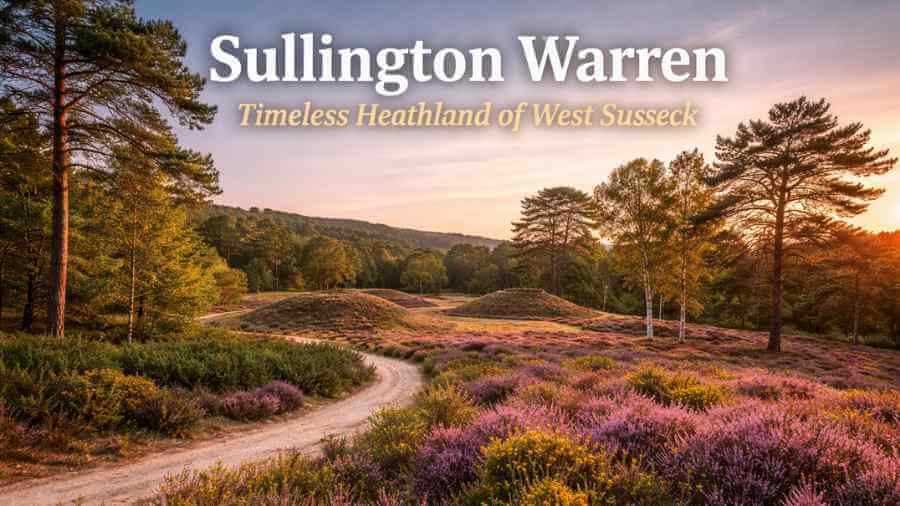
Sullington Warren is one of those rare English landscapes that reveals more the longer you spend within it. Set on the northern edge of the South Downs in West Sussex, this open heathland feels both ancient and alive, shaped by nature, time, and generations of human interaction. Unlike manicured parks or dramatic tourist landmarks, Sullington Warren offers something subtler: a sense of continuity, tranquillity, and ecological richness that has quietly endured for thousands of years.
Location and Landscape Setting
Sullington Warren lies just east of the village of Storrington, at the foot of the South Downs escarpment. Its position is significant. Sheltered from coastal winds yet open enough to support heathland ecology, the land sits on sandy, acidic soils that have resisted agricultural improvement. These conditions allowed heathland to persist while much of southern England was converted to farmland.
The landscape itself is gently undulating rather than dramatic. Low ridges, shallow valleys, and open expanses of heather are punctuated by scattered scrub and woodland edges. From certain points, there are expansive views towards the Downs, while elsewhere the terrain folds in on itself, creating pockets of seclusion. This variation makes the area feel larger than it is and encourages slow exploration rather than purposeful marching.
Seasonal change transforms the character of the land. In late summer, purple heather dominates the scene, while winter reveals the sculptural quality of bare grasses and ancient earthworks. Spring brings fresh greens and birdsong, and autumn softens the palette with browns and golds.
Heathland Ecology and Rare Habitats
Lowland heathland is one of the rarest habitats in the United Kingdom, and Sullington Warren is an important surviving example. Heathland requires specific conditions: nutrient-poor soil, open sunlight, and careful management to prevent scrub and woodland from taking over. Without intervention, these landscapes disappear, making sites like Sullington Warren increasingly precious.
The heath supports a complex mosaic of plant communities. Heather, gorse, and fine grasses dominate the drier areas, while wetter patches support species adapted to damp, acidic ground. This diversity of microhabitats allows a wide range of insects, birds, and reptiles to coexist within a relatively small area.
Equally important is what is absent. The lack of fertiliser, ploughing, and intensive agriculture has preserved soil conditions that are now rare elsewhere. This ecological continuity is what gives Sullington Warren its conservation value and its distinctive character.
Plant Life and Botanical Interest
The plant life of Sullington Warren rewards close attention. At first glance, the vegetation may appear simple, but careful observation reveals remarkable variety. Heather species provide structure and seasonal colour, while gorse adds texture and shelter for wildlife. In open areas, delicate grasses sway in the wind, contributing to the sense of movement and openness.
In wetter hollows, specialist plants adapted to nutrient-poor conditions can be found. Some are small and easily overlooked, yet they play an essential role in the ecosystem. Mosses and lichens also thrive here, forming living carpets that stabilise soil and support invertebrate life.
This botanical richness makes the site especially valuable to conservationists and botanists. It also enhances the experience for visitors who enjoy observing subtle natural detail rather than obvious spectacle.
Wildlife of Sullington Warren
Wildlife is one of the quiet strengths of Sullington Warren. The open heath, scrub, and woodland edges provide habitat for many species, some of which are declining nationally. Birdlife is particularly notable. Woodpeckers are frequently heard rather than seen, while nuthatches, kestrels, and other woodland and open-country birds use the varied habitat throughout the year.
Insects thrive in the warm, open conditions of the heath. Bees, beetles, and butterflies are abundant in summer, drawn to flowering plants and sunlit ground. These insects, in turn, support birds and small mammals, creating a healthy and interconnected ecosystem.
Reptiles such as adders, slow worms, and common lizards are present but elusive. They depend on the mosaic of open ground and shelter, basking in sunny patches while retreating into vegetation when disturbed. Their presence is a sign of a well-managed heathland, as these species are highly sensitive to habitat change.
Archaeological Significance and Ancient History
One of the most striking aspects of Sullington Warren is the visible presence of ancient human history. Bronze Age burial mounds, known as round barrows, sit quietly on the higher ground. These earthworks are subtle yet powerful reminders that this landscape has been important to people for millennia.
The barrows suggest ritual, ceremony, and a deep connection between early communities and the land they inhabited. Their placement on prominent points indicates an awareness of landscape and skyline that still resonates today. Walking past them, it is impossible not to reflect on the continuity of human presence and the changing ways in which people have related to this place.
Archaeological evidence also points to earlier activity, including flint tools from the Mesolithic period. This long timeline reinforces the idea that Sullington Warren is not simply a natural space, but a cultural one shaped by both environment and human decision-making.
Historical Land Use and Rural Life
Beyond prehistory, Sullington Warren has played a role in more recent rural life. The term “warren” traditionally refers to land used for rabbit keeping, grazing, and common rights. For centuries, such areas were essential to local economies, providing fuel, food, and grazing land for nearby communities.
A windmill once stood on the site, serving the surrounding area before being destroyed by fire in the early twentieth century. Although it no longer stands, its memory adds another layer to the story of human adaptation and use of the landscape.
Over time, changing agricultural practices and land ownership reduced the economic role of heathland. What was once valued for utility is now valued for heritage and conservation, reflecting broader shifts in how rural landscapes are perceived.
Conservation and Modern Management
Today, Sullington Warren is carefully managed to preserve its unique character. Conservation work focuses on maintaining open heathland, controlling invasive scrub, and protecting sensitive species. This is not about freezing the landscape in time, but about guiding natural processes in a way that sustains biodiversity.
Management practices include selective clearance of trees, grazing where appropriate, and monitoring of wildlife populations. These actions ensure that heathland does not gradually disappear beneath woodland, a fate that has already befallen many similar sites.
Public access is also managed with care. Paths are informal and understated, encouraging responsible use rather than heavy footfall. Visitors are gently reminded that this is a shared space where nature comes first.
Walking, Exploration and Quiet Recreation
Walking through Sullington Warren is an experience defined by calm rather than challenge. Paths wind naturally through the heath, offering opportunities for short strolls or longer, meandering explorations. There is no single route or destination; the pleasure lies in wandering and discovery.
Unlike busier sections of the South Downs, the atmosphere here remains peaceful even on fine days. The absence of crowds allows visitors to hear birdsong, feel the wind across open ground, and notice small details underfoot. It is a place where walking becomes a form of quiet reflection rather than exercise alone.
Photography, sketching, and nature observation are particularly rewarding here. The changing light across open heath and the subtle textures of vegetation provide endless inspiration for those willing to slow down.
Seasonal Character and Changing Moods
Each season brings a different mood to Sullington Warren. Spring is marked by renewal, with fresh growth and increasing wildlife activity. Summer is the most visually striking period, as heather blooms and insects fill the air. Autumn introduces a softer, more muted palette, while winter strips the landscape back to its essentials.
These seasonal shifts highlight the resilience and adaptability of heathland ecosystems. They also encourage repeat visits, as the same path can feel entirely different at different times of year.
For local residents, this cyclical change creates a sense of familiarity and belonging. For visitors, it offers a reminder of the natural rhythms that underpin rural life.
Cultural Value and Sense of Place
Beyond its ecological and historical importance, Sullington Warren holds cultural value as a place of quiet continuity. It represents a type of English landscape that has become increasingly rare: open, unfenced, and shaped by long-term interaction between people and nature.
Its understated beauty challenges the idea that significance must be dramatic or monumental. Instead, value is found in subtlety, resilience, and the accumulation of stories over time. This sense of place is what leaves a lasting impression on those who visit.
Conclusion
Sullington Warren is far more than an area of open land. It is a living record of natural processes, human history, and careful stewardship. From its rare heathland habitats and diverse wildlife to its ancient barrows and traces of rural life, the landscape tells a story that spans thousands of years.
In an age of rapid change and increasing pressure on the countryside, Sullington Warren stands as a reminder of what can be preserved through respect, understanding, and thoughtful management. It offers quiet beauty rather than spectacle, depth rather than display, and a connection to the land that feels both timeless and deeply relevant today.