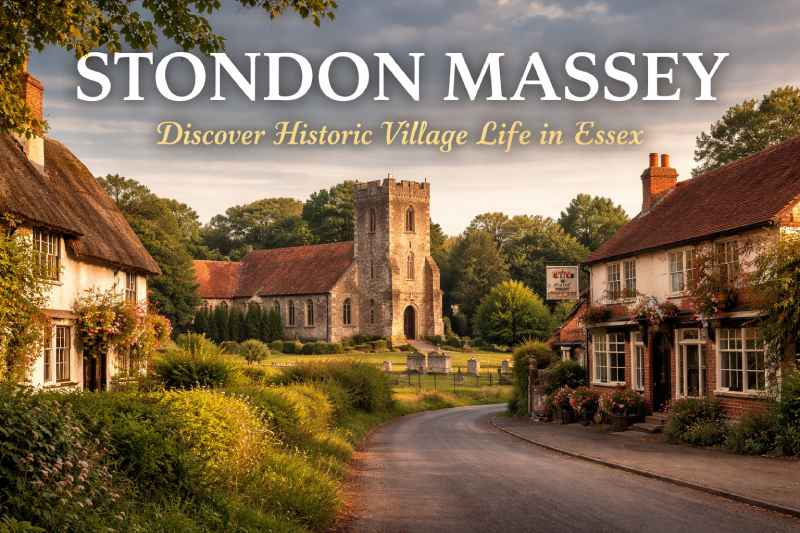
Stondon Massey is one of those rare English villages that quietly carries centuries of history within its hedgerows, lanes, and fields. Nestled in the county of Essex, it offers a compelling blend of rural tranquillity, historical depth, and community spirit. While it may not be widely known outside the region, Stondon Massey holds a distinctive place in England’s cultural and architectural landscape. Its enduring appeal lies not in grand attractions, but in its authenticity—a place where time seems to move gently, and heritage remains woven into everyday life.
Location and Setting
Stondon Massey is located in the Borough of Brentwood in Essex, approximately 20 miles northeast of central London. Despite its proximity to the capital, the village retains a distinctly rural character. Surrounded by farmland, woodlands, and open countryside, it offers a peaceful retreat from the urban pace of nearby towns.
The village is positioned near other small settlements such as Blackmore and Doddinghurst, forming part of a network of rural communities often referred to as the “Five Parishes.” This setting enhances its sense of isolation and charm, making it a place where traditional English village life continues largely uninterrupted.
Origins and Etymology
The name Stondon Massey reflects its deep historical roots. “Stondon” is derived from Old English, meaning “stone hill,” suggesting that the area may have been known for its geological features or elevated terrain. “Massey,” on the other hand, originates from the Norman family of Serlo de Marcy, who held land in the area following the Norman Conquest of 1066.
This combination of Anglo-Saxon and Norman influences in the village’s name mirrors the broader historical evolution of England itself. It signals a continuity of settlement and governance that stretches back nearly a thousand years, making Stondon Massey a living record of the nation’s past.
Early History and Development
Archaeological and historical evidence suggests that Stondon Massey has been inhabited since Saxon times. Like many English villages, it likely began as a small agricultural settlement, with farming forming the backbone of its economy and way of life.
The medieval period was particularly significant in shaping the village. During this time, the construction of the parish church and the establishment of local governance structures helped define the community. However, the Black Death in the mid-14th century had a profound impact. It is believed that the original settlement centre shifted southwards after the plague, as surviving residents relocated to safer or more favourable ground.
This shift in settlement patterns is still visible today, with the church standing somewhat apart from the main cluster of modern homes—a quiet reminder of the village’s medieval past.
Architectural Heritage
One of the most striking aspects of Stondon Massey is its architectural heritage. The village features a mix of historic and more recent buildings, many of which reflect traditional English styles.
St Peter and St Paul Church
At the heart of the village’s history is the Church of St Peter and St Paul. Dating back to the 12th century, this Grade I listed building is an important example of medieval ecclesiastical architecture. Its structure includes elements from different periods, illustrating the gradual evolution of church design over centuries.
The church is also notable for its association with the composer William Byrd, who is buried there. This connection adds cultural significance to the site, linking the village to one of England’s most influential figures in music history.
Traditional Houses and Farmsteads
Many of the houses in Stondon Massey are built in traditional styles, featuring timber frames, thatched roofs, and brickwork typical of Essex. These properties often date back several centuries and have been carefully maintained or restored.
Farmsteads and agricultural buildings remain a key feature of the landscape, reinforcing the village’s rural identity. Even newer developments tend to respect the established architectural character, ensuring that the visual harmony of the area is preserved.
William Byrd and Cultural Significance
Stondon Massey holds a unique place in England’s cultural history due to its association with William Byrd, one of the most important composers of the Renaissance period. Byrd lived in the village from 1593 until his death in 1623.
During his time in Stondon Massey, Byrd composed many of his most significant works, including sacred music that continues to be performed today. His presence in the village reflects a period when rural England could still serve as a centre of intellectual and artistic activity.
Byrd’s burial in the parish church adds a layer of historical depth, making Stondon Massey not just a rural settlement, but a place of national cultural importance.
Social Life and Community
Despite its small size, Stondon Massey has a strong sense of community. Village life revolves around shared spaces and events, fostering connections among residents.
Village Events
One of the highlights of the year is the village fete, a traditional event that brings together locals and visitors alike. These gatherings typically feature games, food stalls, and entertainment, reflecting long-standing English customs.
Such events play a crucial role in maintaining community cohesion, especially in rural areas where social interaction may otherwise be limited.
Local Amenities
While Stondon Massey does not have the extensive amenities of larger towns, it offers essential facilities such as a village hall and a local pub. These spaces serve as informal meeting points, where residents can socialise and exchange news.
The limited commercial development helps preserve the village’s peaceful atmosphere, making it an attractive place for those seeking a slower pace of life.
Economy and Land Use
Agriculture has historically been the primary economic activity in Stondon Massey, and it continues to play an important role today. The surrounding fields are used for various forms of farming, including arable crops and livestock.
In recent years, there has been some diversification, with residents commuting to nearby towns or even London for work. This blend of traditional and modern economic patterns reflects broader changes in rural England.
However, the village has managed to avoid overdevelopment, maintaining a balance between economic viability and environmental preservation.
Natural Environment
The natural environment of Stondon Massey is one of its greatest assets. The village is surrounded by open countryside, with fields, hedgerows, and small woodlands creating a picturesque landscape.
Wildlife and Ecology
The area supports a variety of wildlife, including birds, small mammals, and insects. The presence of traditional farming practices and relatively low levels of urbanisation contribute to a healthy ecosystem.
Walking and Outdoor Activities
Stondon Massey is an ideal location for walking and outdoor exploration. Public footpaths and country lanes allow visitors to experience the landscape up close, enjoying views that change with the seasons.
For those interested in nature and tranquillity, the village offers a refreshing contrast to more crowded tourist destinations.
Modern Life in Stondon Massey
While Stondon Massey retains its historical character, it is not frozen in time. Modern developments have brought changes, albeit in a measured and respectful manner.
Housing and Population
The village has seen modest growth in housing, accommodating a population of around 700 residents. New homes are typically designed to blend with the existing architectural style, ensuring continuity in appearance.
Connectivity
Despite its rural setting, Stondon Massey is reasonably well connected. Nearby towns provide access to rail services and major roads, making it possible for residents to commute or travel with relative ease.
This combination of accessibility and seclusion is one of the factors that make the village appealing to a wide range of people.
Challenges and Preservation
Like many rural communities, Stondon Massey faces certain challenges. These include:
- Maintaining infrastructure with a small population base
- Balancing development with conservation
- Ensuring that younger generations remain engaged with village life
Efforts to preserve the village’s character are ongoing, with local planning policies and community initiatives playing a key role. The aim is to protect what makes Stondon Massey unique while allowing it to adapt to changing circumstances.
Why Stondon Massey Matters
Stondon Massey may appear modest at first glance, but its significance lies in what it represents. It embodies the enduring qualities of rural England—history, continuity, and community.
In an age of rapid urbanisation and technological change, places like Stondon Massey provide a valuable reminder of simpler ways of living. They offer insight into the past while demonstrating how tradition can coexist with modern life.
For visitors, the village offers a chance to step away from the noise and complexity of contemporary society. For residents, it provides a sense of belonging and identity that is increasingly rare.
FAQs
What is Stondon Massey known for?
Stondon Massey is known for its historic church, its association with composer William Byrd, and its well-preserved rural character.
Where is Stondon Massey located?
Stondon Massey is located in Essex, England, within the Borough of Brentwood, not far from London.
Is Stondon Massey a good place to live?
Yes, Stondon Massey is considered a peaceful and desirable place to live, particularly for those who appreciate countryside settings and a close-knit community.
Can visitors explore Stondon Massey?
Visitors can explore the village, enjoy walks in the surrounding countryside, and view historical sites such as the parish church.
Why is William Byrd important to Stondon Massey?
William Byrd lived in Stondon Massey for many years and is buried there. His presence adds cultural and historical significance to the village.
Conclusion
Stondon Massey stands as a quiet yet powerful example of England’s rural heritage. From its Saxon origins and Norman influences to its association with William Byrd, the village offers a rich tapestry of history and culture. Its traditional architecture, strong community spirit, and beautiful natural surroundings make it a place of enduring appeal.
In a world that often prioritises speed and expansion, Stondon Massey reminds us of the value of preservation, simplicity, and connection to the past. Whether you are exploring it for the first time or studying its history in depth, the village leaves a lasting impression—one that speaks of continuity, resilience, and understated beauty.