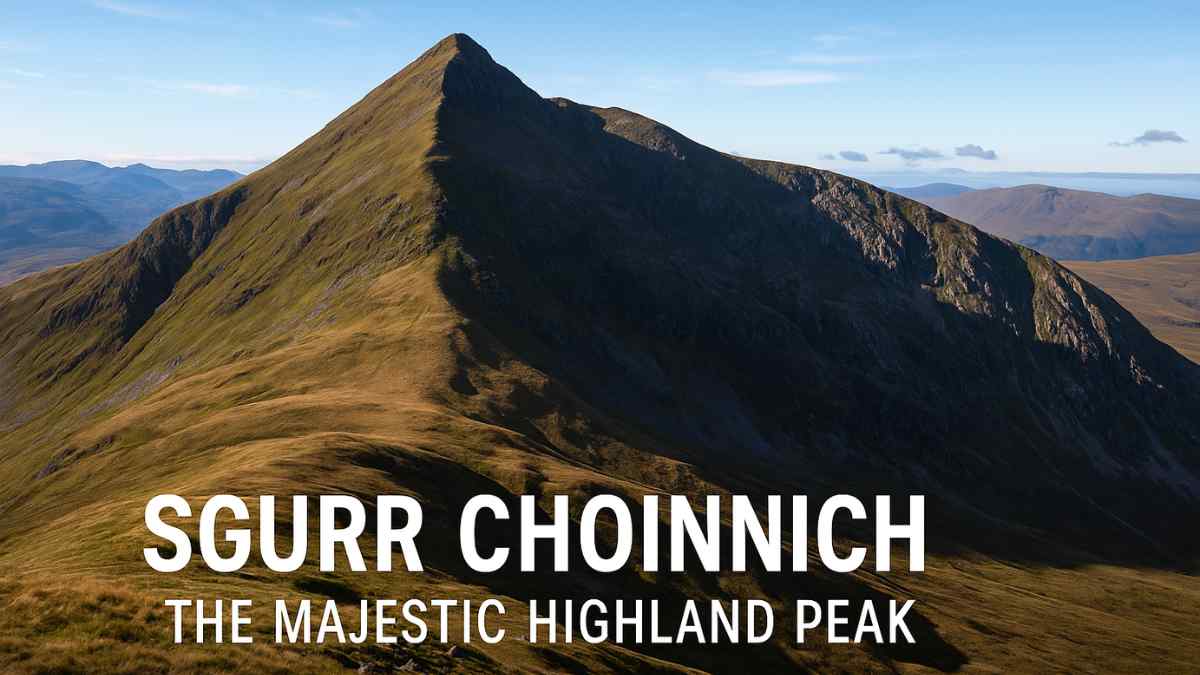
Deep within the wild heart of the Scottish Highlands lies one of the most striking yet underrated Munros — Sgurr Choinnich. With an elevation of 999 metres, this mountain offers not only a challenging ascent but also a mesmerising glimpse into the rugged beauty of Scotland’s landscape. Its name, derived from Gaelic, translates to “the peak of Kenneth” or “the mossy peak,” embodying the fusion of history, culture, and natural grandeur that defines this part of the Highlands.
Situated between Glen Carron and Loch Monar, Sgurr Choinnich rises proudly within a remote and tranquil setting, captivating both seasoned climbers and nature lovers who seek solitude and serenity. This mountain may not boast the height of Ben Nevis or the fame of Buachaille Etive Mòr, but its charm lies in its isolation, steep ridges, and panoramic views that seem to stretch endlessly across the northwest Highlands.
The Geographic Setting of Sgurr Choinnich
Sgurr Choinnich stands as part of the Northwest Highlands, an area celebrated for its dramatic terrain, ancient geology, and sense of untouched wilderness. The mountain’s summit ridge stretches east to west, overlooking deep corries and glens carved by glaciers thousands of years ago. The northern face of the mountain plunges sharply into Coire Choinnich, with cliffs and crags that contrast sharply with the smoother, grass-covered slopes of its southern flank.
To its west lies its slightly higher neighbour, Sgurr a’ Chaorachain, another Munro often climbed in the same expedition. Together, these two peaks form a rewarding ridge walk that is both challenging and immensely scenic. The mountain is surrounded by sprawling moorlands, streams, and forested areas that come alive with wildlife — from soaring golden eagles to red deer grazing in the distance.
The isolation of Sgurr Choinnich is one of its most defining features. It is far removed from major towns and roads, providing hikers with the feeling of true escape from the modern world. The nearest road access is along the A890 near Craig in Glen Carron, from where most ascents begin. The journey from this starting point into the mountain’s heart is an adventure in itself, involving forest tracks, burns, and vast open glens.
Climbing Routes and Ascent Experience
Reaching the summit of Sgurr Choinnich is both a physical and mental challenge, but one that rewards every ounce of effort. The most popular route begins from Craig, where a well-defined track follows the Allt a’ Chonais burn into a secluded valley. As hikers progress deeper into the glen, civilisation fades away, replaced by the constant sound of flowing water and the rustle of Highland winds.
The path eventually leads to Bealach Bhearnais, a mountain pass that connects Sgurr Choinnich with Sgurr a’ Chaorachain. From here, the climb becomes steeper and rockier. The final approach to the summit follows a narrow ridge that can be challenging in wet or windy weather but is never overly technical. On clear days, the ridge offers stunning views of the Torridon peaks to the north and the wilderness of Loch Monar to the south.
For those who enjoy a longer expedition, combining both Sgurr Choinnich and Sgurr a’ Chaorachain makes for a memorable traverse. The route spans around 20 kilometres and typically takes between seven and nine hours, depending on pace and conditions. Although the ascent demands stamina, it remains achievable for experienced walkers who are comfortable navigating steep terrain and changing weather.
The Summit and Its Spectacular Views
Standing on the summit of Sgurr Choinnich is an experience that captures the soul of the Highlands. The ridge-top cairn marks the culmination of the journey, offering one of the most spectacular viewpoints in the region. To the north, you can admire the striking profiles of the Torridon giants — Liathach, Beinn Alligin, and Beinn Eighe — their jagged peaks cutting against the sky. To the south, the land falls away into the remote wilderness surrounding Loch Monar, a shimmering expanse of water framed by mountains.
The sense of silence and scale here is profound. Many climbers describe it as a humbling experience — the feeling of standing atop a solitary summit, surrounded by miles of untouched beauty. The crisp Highland air, the sound of distant burns, and the endless sky create a meditative atmosphere that is difficult to replicate anywhere else in Britain.
In winter, Sgurr Choinnich transforms into a snow-clad wonderland. The slopes become a mixture of white ridges and frozen streams, attracting mountaineers who enjoy the challenge of ice axes and crampons. Yet even in the harshest conditions, the mountain retains a serene grace, reminding visitors why Scotland’s Munros are so deeply cherished.
Wildlife and Natural Environment
The slopes and glens surrounding Sgurr Choinnich are teeming with life. Despite its apparent barrenness, the Highland ecosystem thrives with unique flora and fauna adapted to the rugged climate. Red deer, Scotland’s largest land mammals, are a common sight, often silhouetted against the horizon. Golden eagles patrol the skies, their powerful wings casting shadows over the corries below.
In the summer months, the lower slopes bloom with wildflowers and heather, turning the hillsides into a mosaic of purple and green. The streams running from the mountain are crystal clear, home to trout and a variety of aquatic life. For photographers and nature enthusiasts, the region provides endless opportunities to capture Scotland’s untamed beauty.
The environment here demands respect. Weather conditions can change rapidly, and the remoteness of the area means that hikers must come prepared — not just physically, but with a sense of responsibility towards the land. The “Leave No Trace” principle is crucial, ensuring that the wilderness remains pristine for future generations.
Cultural and Linguistic Heritage
The name Sgurr Choinnich originates from the Gaelic language, reflecting Scotland’s deep cultural heritage. “Sgurr” translates to “peak” or “sharp hill,” while “Choinnich” is linked to “Coinneach” or “Kenneth,” potentially referencing a saint or an early inhabitant associated with the area. Gaelic names like this are found throughout the Highlands, acting as linguistic echoes of Scotland’s ancient past.
The surrounding region also carries a rich tapestry of history — from ancient clan territories to tales of Highland life before the Clearances. Many of the glens and ridges bear names that describe the landscape or honour past figures, offering insight into how deeply the Scottish people have always been connected to their environment.
Tips for Hikers and Visitors
For anyone planning to climb Sgurr Choinnich, preparation is key. The mountain’s remoteness means that even small oversights can become significant challenges. Here are a few essential tips for a safe and enjoyable climb:
- Plan for the Weather: The Highlands are known for unpredictable conditions. Always check forecasts and be ready for sudden changes in wind, rain, or visibility.
- Start Early: The route is long, and daylight can be limited outside of summer. Beginning early ensures ample time for a safe return.
- Carry Navigation Tools: A map, compass, and GPS are crucial. Cloud and mist can descend rapidly, obscuring landmarks.
- Pack Essentials: Include waterproof gear, warm clothing, extra food, and a first-aid kit.
- Respect Nature and Local Land Use: The area is occasionally used for deer stalking; checking local estate notices before your visit helps avoid conflicts.
The Allure of Isolation
What sets Sgurr Choinnich apart is not merely its height or steepness but its sense of remoteness. Unlike more tourist-heavy Munros, this mountain offers peace and solitude. On most days, you may encounter only a handful of other climbers, if any. The quietness enhances the spiritual quality of the journey — it feels like walking through a world untouched by time.
This solitude has made Sgurr Choinnich a favourite among mountaineers who seek a more authentic Highland experience. The absence of crowds, the raw scenery, and the demanding terrain combine to create a journey that is as introspective as it is physical.
Comparison with Neighbouring Peaks
While nearby Munros like Sgurr a’ Chaorachain and Moruisg may attract attention for their slightly greater height, many walkers consider Sgurr Choinnich the more characterful climb. Its ridge is narrower, its views more dramatic, and its summit more rewarding. The contrast between its craggy northern face and its gentler southern slopes gives it a distinctive profile, often described as “elegant” among Scotland’s peaks.
When climbed together, the pair of Sgurr Choinnich and Sgurr a’ Chaorachain offers a complete Highland adventure — a blend of endurance, navigation, and sheer natural beauty.
Why Sgurr Choinnich Deserves Recognition
Sgurr Choinnich may not dominate travel brochures or Instagram feeds, yet it embodies everything that makes the Scottish Highlands extraordinary: solitude, grandeur, history, and the quiet strength of nature. It is a mountain that commands respect not through its fame but through its atmosphere — the way it makes climbers feel connected to something timeless and vast.
Every ascent is a reminder of the fragile balance between human effort and natural majesty. Those who reach its summit often speak of a renewed appreciation for the land and a sense of calm that only such wild places can inspire.
Conclusion
Sgurr Choinnich stands as a symbol of Scotland’s unspoiled wilderness — a mountain that invites adventure, reflection, and reverence. With its sweeping views, cultural depth, and wild setting, it offers a truly unforgettable experience for those willing to undertake the journey.
Climbing it is not merely a physical achievement but an emotional encounter with the heart of the Highlands. The air feels purer, the silence deeper, and the landscape more alive. For anyone seeking to understand the soul of Scotland, a walk up Sgurr Choinnich is not just recommended — it is essential.