Clydebridge Steelworks: A Monument of Scotland’s Industrial Strength and Steelmaking Heritage

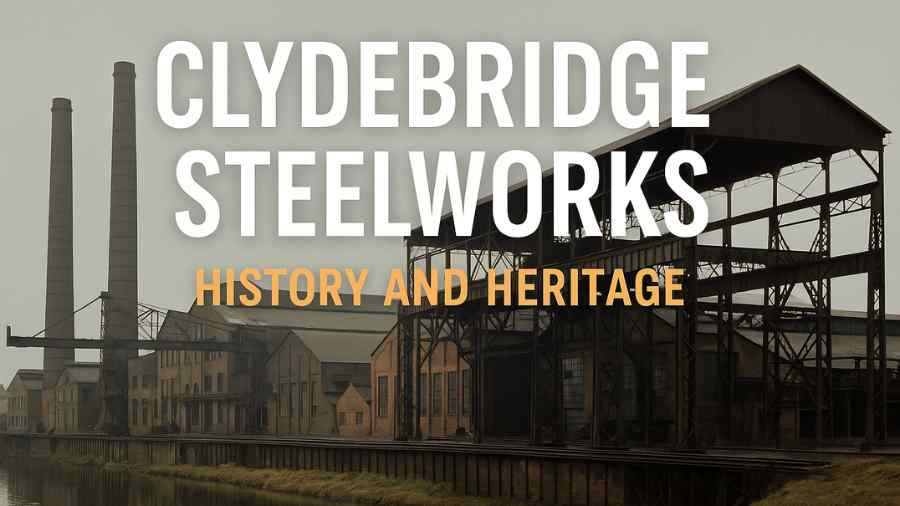
Clydebridge Steelworks stands as one of Scotland’s most iconic industrial landmarks, a site that once thrummed with the sound of machines, burning furnaces, and thousands of hardworking men shaping molten metal into steel plates that strengthened ships, infrastructure, and wartime production. Situated between Rutherglen and Cambuslang on the River Clyde, the steelworks became a symbol of Scotland’s industrial might. It was not merely a factory; it was a community cornerstone, a workplace that fed families, built cities, and helped forge the history of Britain’s heavy industry.
Founding and Early Development
The origins of Clydebridge Steelworks date back to the late nineteenth century. Established in 1887, it emerged at a time when Britain was a global steel powerhouse. Railways were expanding, shipbuilding was booming along the Clyde, and industrialisation demanded strong, reliable metal output. Clydebridge answered that call.
The plant was strategically built on fertile industrial ground that had already witnessed iron production. What began as an ambitious steelmaking facility soon evolved into a centre focused heavily on plate production. These plates would later become crucial for marine engineering and heavy machinery. The early works contained open-hearth furnaces, rolling mills, and ancillary workshops designed for mass processing. Engineers and labourers worked side by side, refining molten steel with techniques that required precision, coordination, and endurance.
Growth was not without struggle. Economic fluctuations affected the plant, and at one point, the site experienced a temporary closure. Yet the steelworks survived, reopening to meet industrial demand and gradually expanding operations as global need for steel increased. This willingness to revive and adapt became a defining trait of Clydebridge for many decades.
Role in Shipbuilding and Engineering
Clydebridge Steelworks became deeply woven into Scotland’s maritime history. As the Clyde riverbanks filled with shipyards constructing ocean liners, cargo vessels, naval ships, and tankers, the steelworks became an indispensable supplier. Its steel plates were known for durability and toughness, enabling shipbuilders to create vessels capable of withstanding ocean pressure and long voyages.
The steel rolled here contributed to the golden age of Clyde shipbuilding. This era shaped Glasgow’s reputation across the world as a leader in marine engineering. Ships built with Clydebridge steel sailed through the Atlantic, defended Britain in naval operations, and carried goods and people across continents. The steelworks thus played a silent but essential role in international commerce, national defence, and migration.
Beyond shipbuilding, Clydebridge produced materials for locomotives, bridges, boilers, and heavy engineering components. Industries relied on the plant’s consistency, ensuring Clydebridge steel travelled far beyond Scotland’s borders. Every steel plate forged on site represented craftsmanship, skill, and human dedication.
Contribution During Wartime
During both World Wars, Clydebridge Steelworks became a vital cog in Britain’s defence machinery. Demand surged for armour plate, naval components, and military-grade steel products. Workers laboured tirelessly in intense heat to meet wartime needs, often under pressure to deliver quickly without compromising quality. Families recall stories of men leaving home before dawn and returning late into the night, exhausted yet proud to be supporting their country’s efforts.
Women also stepped into industrial roles during wartime shortages, operating machines, handling administrative duties, and proving that the steel industry was not solely a male environment during national emergencies. Clydebridge became a source of patriotism and unity, with the chimneys symbolising strength during uncertain times.
With government involvement increasing, upgrades were introduced to enhance melting capacity and steel output. Wartime expansion placed Clydebridge among the key Scottish sites supporting Britain’s military mission. Its impact cannot be measured only in tonnage; it must also be measured in hope, security, and resilience during turbulent decades.
Industrial Peak and Workforce Culture
By the mid-twentieth century, Clydebridge Steelworks had grown to impressive scale, employing thousands of workers. It was not just a job site — it was a community ecosystem. Local economies thrived, nearby housing expanded, and generations of families found lifelong employment inside the steelworks gates. Skills were passed down from father to son, stories shared during shifts, and friendships forged through the shared hardships of industrial labour.
Life inside the steelworks was tough. Temperatures near furnaces were extreme, labour was physically demanding, and safety standards of the early decades were nothing like those of modern times. Yet for many workers, Clydebridge was a source of identity and pride. The rhythmic hammering, steam pressure whistling, and glowing steel became part of their daily soundtrack.
This period represented the height of Scotland’s industrial economy. Steelworks like Clydebridge stood tall as engines of progress, connected to rail yards, shipping lanes, and factories across the UK. The plant’s workforce shaped not only metal but the social fabric of towns surrounding it.
Decline and Closure of Steel Production
As global steel dynamics shifted in the later twentieth century, Clydebridge began to feel the pressure. Foreign competition increased, new technologies replaced open-hearth methods, and industrial decline swept across Britain. Many traditional steel giants struggled to modernise fast enough. For Clydebridge, maintaining competitiveness became increasingly difficult.
Steelmaking operations ceased in 1978, marking a painful turning point. Although plate rolling continued for several years, the final plate was rolled in 1982, symbolising the end of an era. Workers faced redundancy, communities felt the economic strain, and once-busy furnaces fell silent. The closure reflected a broader industrial contraction across the UK, but for local families it was deeply personal — a loss of heritage, income, and identity.
Large portions of the site were later dismantled or repurposed. Buildings once filled with noise and life became echoes of history. Only fragments of the original infrastructure remained, standing as industrial ruins that reminded Scotland of what once was.
Attempts at Revival and Modern Operations
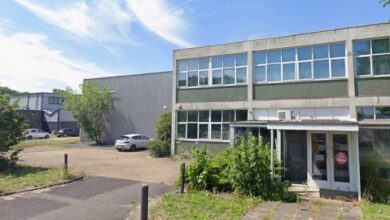
Despite the decline, Clydebridge Steelworks never fully disappeared. Parts of the site were revitalised for specialist heat treatment, quenching, and finishing work. Ownership changed hands more than once, with efforts made to sustain operations on a smaller scale. While the workforce never returned to thousands, the persistence of industrial activity allowed the Clydebridge name to survive into the modern era.
The shift from full steel production to niche processing represented adaptation in the face of economic change. Smaller teams of skilled workers continued to carry the legacy forward, proving that although the industrial age had transformed, its spirit lived on.
The steelworks of today is a shadow of its former vastness, yet its cultural weight remains disproportionally strong. The name still invokes history, pride, and architectural memory. To many Scots, Clydebridge isn’t just a factory — it is heritage.
Architectural Remnants and Historical Memory
Visitors still find traces of Clydebridge’s industrial past. Some structures stand weathered but proud, visual markers of the steel age. Rusted beams, old foundations, and redeveloped patches of land form an industrial landscape that sparks imagination about what once stood there. For historians, photographers, and local residents, these remnants act as open-air museums.
Stories are preserved through archives, recorded memories, family photographs, and oral tradition. Museums highlight the role of steel in Scotland’s identity, and Clydebridge features as a cornerstone of those narratives. Industrial archaeology enthusiasts study the site to understand metallurgical technique, workforce conditions, and the evolution of steel technology.
Even though modern development has reshaped sections of land, the spirit of Clydebridge lingers. Every surviving building, railway trace, and rusted structure offers a connection to an era when steel defined the region.
Why Clydebridge Steelworks Still Matters
Clydebridge Steelworks represents more than a production site. It symbolises innovation, sacrifice, industrial power, and community life. From shaping naval ships to supporting wartime manufacturing, its influence stretched far beyond Cambuslang and Rutherglen. Its story teaches lessons about economic evolution — how industries rise, dominate, decline, and attempt renewal.
Studying Clydebridge gives insight into Britain’s transformation from heavy manufacturing toward modern economies. It reminds us of the human labour behind industrial revolutions. Most importantly, it keeps alive the lives and stories of workers who dedicated themselves to generations of steelmaking.
Today, Clydebridge holds a place not just in history books, but in the hearts of families connected to its legacy. As long as those stories continue to be told, the steelworks will never be forgotten.
Conclusion
Clydebridge Steelworks stands as a monumental chapter in Scotland’s industrial heritage. From its establishment in the late 19th century to its vital contribution in wartime and its peak years employing thousands, it shaped communities and strengthened nations. Its steel plates sailed oceans, built ships, and aided Britain through conflict. Although the furnaces no longer roar with the intensity they once did, their memory continues to burn brightly in Scottish history.
The decline and partial closure of Clydebridge reflect global shifts in industry, but they also show how heritage persists even after machinery stops. Modern remnants of the steelworks, though quieter, still represent craftsmanship, resilience, and pride. Clydebridge Steelworks remains a story of people, progress, struggle, and legacy — a landmark carved into the identity of the Clyde and into the broader story of Britain’s industrial journey.