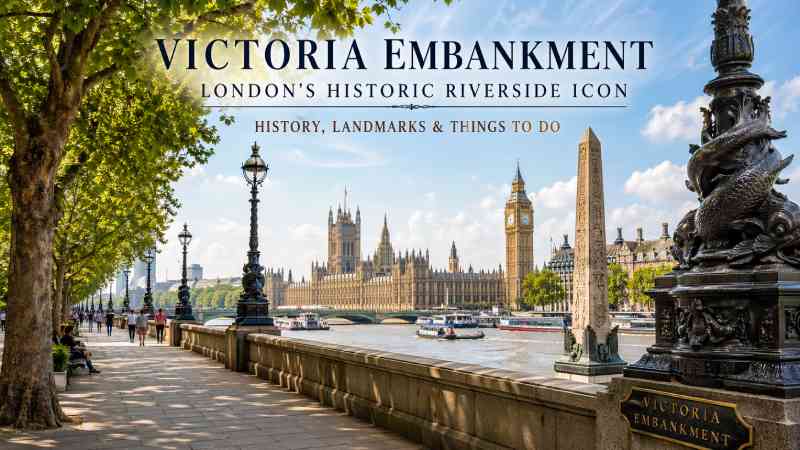
Victoria Embankment stands as one of London’s most remarkable achievements, seamlessly blending engineering innovation, urban planning, and aesthetic beauty. Stretching along the north bank of the River Thames, it is far more than a simple road or promenade. It represents a transformative moment in the history of the city—when London confronted its environmental, infrastructural, and public health challenges with bold ambition.
The Origins of Victoria Embankment
To understand Victoria Embankment, one must first understand London in the mid-19th century. At that time, the city was expanding rapidly due to industrialisation. However, its infrastructure had not kept pace with its growth. The River Thames, once a vital source of life and commerce, had become heavily polluted.
The turning point came during the infamous “Great Stink” of 1858. The summer heat intensified the odour of untreated sewage flowing into the Thames, making conditions unbearable—even within the Houses of Parliament. This crisis forced authorities to act decisively.
The solution was ambitious: build a modern sewer system and, at the same time, reclaim land from the river to create new roadways and public spaces. This vision ultimately gave birth to Victoria Embankment.
The Vision of Joseph Bazalgette
At the heart of this transformation was the brilliant engineer Joseph Bazalgette. His design for London’s sewer system was revolutionary. Instead of allowing waste to flow directly into the Thames, Bazalgette proposed a network of intercepting sewers that would divert sewage downstream.
Victoria Embankment was a key part of this plan. By constructing a solid embankment along the river, engineers could house large sewer pipes beneath the surface while also creating space above for roads and public areas.
Bazalgette’s foresight extended beyond immediate needs. He deliberately oversized the sewer system, anticipating future population growth. This decision proved crucial, as much of his system remains in use today.
Construction and Development
The construction of Victoria Embankment began in 1865 and was completed in 1870. It was officially opened by the future King Edward VII, then the Prince of Wales. The project required reclaiming land from the Thames, which involved building massive retaining walls and filling in sections of the riverbank.
This was no ordinary construction effort. It integrated multiple layers of infrastructure within a single structure:
- A major roadway to ease congestion in central London
- Underground sewer systems designed by Bazalgette
- Gas and water pipes
- The District Railway, now part of the London Underground
This multi-functional design made Victoria Embankment one of the earliest examples of modern urban infrastructure planning.
The project was named after Queen Victoria, reflecting the grandeur and ambition of the era.
Engineering Excellence Beneath the Surface
While the surface of Victoria Embankment is visually appealing, its true brilliance lies beneath. The embankment houses large brick-lined sewer tunnels that were constructed with remarkable precision.
These tunnels were built using millions of bricks and designed to handle enormous volumes of wastewater. Their durability is a testament to Victorian engineering standards.
In addition to sewage management, the embankment also accommodated the early District Railway. Running partially underground, this railway improved transportation across London and contributed to the development of the modern Underground network.
The integration of transport, sanitation, and utilities within a single structure was revolutionary at the time and remains influential in urban planning today.
Transformation of the River Thames
Before the construction of Victoria Embankment, the River Thames had wide, muddy banks that were prone to flooding and pollution. The embankment project effectively reshaped the river’s edge.
By pushing the river back and creating a defined boundary, engineers reduced flooding risks and improved navigation. The cleaner flow of water, combined with the new sewer system, gradually restored the Thames to a healthier state.
This transformation marked a turning point in London’s environmental history. The river, once considered a hazard, began its journey towards becoming the iconic landmark it is today.
Victoria Embankment Gardens: A Green Oasis
One of the most beloved features of Victoria Embankment is its gardens. Created on reclaimed land, the Victoria Embankment Gardens provide a peaceful escape from the bustle of the city.
These gardens are carefully landscaped with lawns, flowerbeds, and mature trees. They offer a tranquil setting where visitors can relax, read, or simply enjoy the surroundings.
The gardens also reflect Victorian ideals of public space. During the 19th century, there was a growing belief that access to green areas was essential for public health and well-being. Victoria Embankment Gardens embodied this philosophy.
Landmarks and Monuments Along the Embankment
Victoria Embankment is rich in historical and cultural landmarks. As one walks along its length, a series of statues, memorials, and architectural features tell the story of London’s past.
Cleopatra’s Needle
One of the most striking features is Cleopatra’s Needle, an ancient Egyptian obelisk that dates back over 3,000 years. It was transported to London in the 19th century and erected along the embankment as a symbol of Britain’s global connections.
Memorials and Statues
The embankment is home to numerous statues honouring important figures, including engineers, military leaders, and politicians. These monuments serve as reminders of the people who shaped the city and the nation.
Historic Features
Hidden among the gardens and pathways are historical remnants such as the York Watergate, which once stood at the edge of the Thames before the embankment was built. Today, it sits inland, highlighting how dramatically the landscape has changed.
The Role of Victoria Embankment in Urban Life
Victoria Embankment quickly became an essential part of London’s urban fabric. It provided a much-needed alternative route to relieve congestion on nearby streets such as the Strand.
Over time, it evolved into a multifunctional space:
- A key transport corridor for vehicles and buses
- A pedestrian-friendly promenade for walking and leisure
- A cultural space featuring events, performances, and gatherings
Its wide pavements and scenic views make it particularly popular among tourists and locals alike.
Architectural and Aesthetic Features
Beyond its functional role, Victoria Embankment is also admired for its architectural beauty. The design incorporates elegant stonework, decorative lampposts, and ornate benches.
The Victorian attention to detail is evident throughout. Even practical elements such as ventilation shafts were designed with aesthetic considerations in mind.
At night, the embankment takes on a different character. The lighting reflects off the Thames, creating a striking visual effect that enhances the atmosphere of central London.
Technological Innovations
Victoria Embankment was at the forefront of technological progress during its time. One notable achievement was its early adoption of electric street lighting.
In 1878, the embankment became one of the first streets in Britain to be illuminated by electricity. This innovation demonstrated London’s willingness to embrace new technologies and set a precedent for modern urban lighting systems.
Social and Cultural Significance
Victoria Embankment is more than an engineering project; it is a social space that reflects the changing dynamics of London life.
In the Victorian era, it symbolised progress and modernity. It showed that the city could overcome its challenges through innovation and planning.
Today, it continues to serve as a gathering place. From casual walks to organised events, the embankment remains an integral part of London’s cultural landscape.
Environmental Impact and Legacy
The environmental impact of Victoria Embankment cannot be overstated. By improving sanitation and controlling pollution, it played a crucial role in enhancing public health.
The project also set a standard for sustainable urban development. It demonstrated how infrastructure could address multiple issues simultaneously, from environmental concerns to transportation needs.
Modern cities around the world continue to draw inspiration from the principles established during the construction of Victoria Embankment.
Victoria Embankment in the Modern Era
In the 21st century, Victoria Embankment remains a vital part of London. While its core structure has endured, it has adapted to meet contemporary needs.
Cycling lanes have been introduced to promote sustainable transport. Public spaces have been maintained and enhanced to ensure accessibility and enjoyment for all.
Despite these updates, the embankment has retained its historic character. It stands as a bridge between the past and the present, offering a glimpse into Victorian ingenuity while serving modern urban life.
A Walk Along Victoria Embankment
Walking along Victoria Embankment is an experience that combines history, scenery, and atmosphere. Starting near Westminster and moving towards Blackfriars, one encounters a continuous blend of natural beauty and architectural interest.
The Thames flows steadily alongside, offering ever-changing views depending on the time of day and weather. Boats pass by, bridges frame the skyline, and the sounds of the city create a lively backdrop.
For many visitors, this walk encapsulates the essence of London—dynamic, historic, and endlessly fascinating.
Why Victoria Embankment Matters Today
Victoria Embankment continues to matter because it represents a successful response to complex urban challenges. It shows how thoughtful design can improve quality of life while preserving beauty and heritage.
Its influence extends beyond London. Urban planners and engineers worldwide study projects like Victoria Embankment to understand how infrastructure can serve multiple purposes effectively.
It is also a reminder of the importance of long-term thinking. The decisions made during its construction continue to benefit the city more than a century later.
FAQs
What is Victoria Embankment used for today?
Victoria Embankment serves as a major road, pedestrian walkway, and public space. It is used for commuting, leisure walks, sightseeing, and events.
Why was Victoria Embankment built?
It was built primarily to improve London’s sewer system, reduce pollution in the Thames, and ease traffic congestion in central areas.
Who designed Victoria Embankment?
The embankment was designed by the civil engineer Joseph Bazalgette, whose work transformed London’s sanitation infrastructure.
Conclusion
Victoria Embankment stands as a powerful symbol of London’s ability to innovate and adapt. Born out of crisis, it transformed the city’s relationship with the River Thames and set new standards for urban development. Its combination of engineering brilliance, aesthetic appeal, and social value ensures that it remains relevant even today.
From its origins in the Victorian era to its role in modern London life, Victoria Embankment continues to inspire. It is not merely a stretch of road or a scenic walkway—it is a testament to what can be achieved when vision, skill, and determination come together to shape the future of a city.