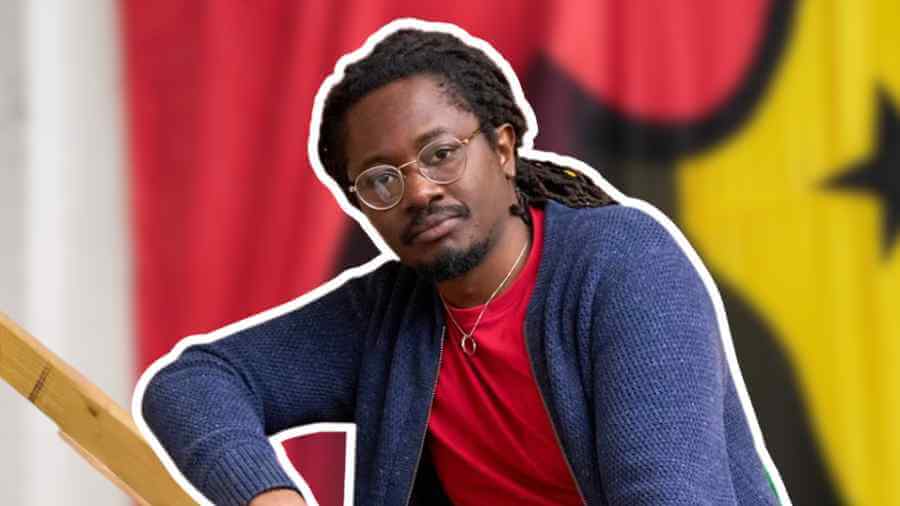
Larry Achiampong is widely recognised as one of the most thoughtful and intellectually rigorous contemporary artists working in Britain today. His practice sits at the intersection of personal memory, collective history, and speculative futures, addressing how colonial legacies, migration, technology, and popular culture continue to shape modern identity. Through film, sound, performance, sculpture, and immersive installation, he constructs layered narratives that ask urgent questions about belonging, power, and cultural inheritance.
Unlike artists who focus on a single medium or fixed aesthetic, Larry Achiampong embraces hybridity. His work is expansive, experimental, and emotionally resonant, often blending autobiography with broader social commentary. This ability to move between the personal and the political has made his practice both accessible and academically significant, appealing to galleries, institutions, and audiences across the world.
Quick Bio
| Profile Detail | Information |
|---|---|
| Full Name | Larry Achiampong |
| Age | 41 years (born 1984) |
| Height | Approx. 5 ft 9 in (175 cm) |
| Nationality | British |
| Ethnicity | British-Ghanaian |
| Profession | Contemporary visual artist, filmmaker, educator |
| Known For | Post-colonial art, film, sound, installation, digital archives |
| Education | BA Mixed Media Fine Art (University of Westminster); MA Sculpture (Slade School of Fine Art) |
| Career Highlights | Relic Traveller series; feature film Wayfinder; major UK and international exhibitions; public art commissions |
| Net Worth | Estimated £500,000 – £1 million (art sales, commissions, film work) |
| Awards & Recognition | Major UK art awards, international residencies, institutional recognition |
| Teaching & Mentorship | Former lecturer and mentor in UK higher education |
| Social Media | Active on Instagram and artist platforms under his professional name |
Early Life and Cultural Roots
Larry Achiampong was born in London in 1984 to Ghanaian parents. Growing up within a British-Ghanaian household meant living between cultures, languages, and value systems. This experience of cultural duality would later become central to his artistic voice. From an early age, he was exposed to Ghanaian traditions, music, storytelling, and spiritual beliefs, while simultaneously absorbing British popular culture, television, video games, and urban life.
This dual perspective allowed him to observe how identity is shaped not as a single fixed state, but as a negotiation between inherited history and lived experience. He has often reflected on how the legacy of colonialism filtered into everyday life through education, media representation, and social expectations. These observations did not remain abstract ideas; instead, they became deeply personal reference points that inform much of his later work.
Education and Artistic Formation
Achiampong studied Mixed Media Fine Art at the University of Westminster, followed by a Master’s degree in Sculpture at the Slade School of Fine Art. These academic environments encouraged experimentation across disciplines rather than technical specialisation alone. During this period, he developed an interest in archives, found materials, sound recordings, and digital media, all of which would become recurring elements in his practice.
Rather than seeing formal education as a constraint, he used it as a space to test ideas, challenge institutional narratives, and develop a critical framework for understanding art’s social role. He became particularly interested in how museums, galleries, and national collections present history, and whose voices are excluded from these narratives.
Artistic Practice and Core Themes
Identity and Post-Colonial Memory
At the heart of Larry Achiampong’s work is an ongoing examination of identity in a post-colonial context. He explores how histories of empire continue to influence modern perceptions of race, nationality, and belonging. Rather than presenting these themes in a didactic manner, he uses storytelling, symbolism, and emotional resonance to invite reflection.
His work frequently addresses the psychological weight of inherited trauma, asking how memories of displacement, exploitation, and cultural erasure are carried across generations. At the same time, he resists narratives of victimhood, focusing instead on resilience, creativity, and the possibility of reimagining the future.
Archives, Sampling, and Re-Contextualisation
Achiampong often works with archives, both official and personal. He samples music, historical documents, television broadcasts, and family stories, weaving them into new compositions that disrupt linear historical narratives. This method reflects his belief that history is not static, but constantly rewritten depending on who controls its interpretation.
By re-contextualising familiar materials, he exposes the assumptions embedded within them and opens space for alternative readings. This approach allows viewers to recognise how deeply ideology can be embedded within everyday cultural artefacts.
Technology and Digital Culture
Video games, digital interfaces, and speculative worlds play a significant role in his work. Achiampong sees digital culture as both a site of liberation and control, where identities can be reshaped but also monitored. His use of game aesthetics and interactive elements reflects a generation shaped by screens, virtual environments, and algorithmic systems.
Rather than treating technology as neutral, he interrogates its relationship with power, surveillance, and representation, particularly in relation to Black bodies and post-colonial subjects.
Major Projects and Works
The Relic Traveller Series
One of Achiampong’s most significant ongoing projects is the Relic Traveller series. This multi-year body of work follows a fictional character navigating landscapes shaped by colonial histories and speculative futures. Through video installations, soundscapes, performances, and objects, the project explores displacement, memory, and survival.
The Relic Traveller acts as both witness and participant, carrying fragments of history while moving through unfamiliar terrain. This narrative device allows Achiampong to explore complex themes in a poetic and emotionally engaging way, avoiding simplistic conclusions.
Collaborative Works and Dialogues
Collaboration is central to Achiampong’s philosophy. He has worked extensively with other artists, writers, and musicians to create dialogues rather than singular statements. These collaborations often explore shared histories, philosophical questions, and speculative narratives, emphasising collective knowledge over individual authorship.
Through these partnerships, he highlights the importance of conversation, disagreement, and mutual learning in the creative process.
Wayfinder and Cinematic Storytelling
Achiampong’s move into feature-length filmmaking marked an important evolution in his practice. Wayfinder follows a young protagonist travelling across England during a period of crisis, blending realism with allegory. The film explores themes of isolation, care, and inherited responsibility, using landscape as a metaphor for emotional and historical terrain.
Rather than relying on spectacle, the film prioritises atmosphere, sound, and quiet moments of reflection. This restrained approach reinforces his broader commitment to thoughtful, human-centred storytelling.
Exhibitions and Public Recognition
Over the years, Achiampong’s work has been exhibited in major galleries, museums, and public spaces across the United Kingdom and internationally. His installations often transform exhibition spaces into immersive environments, encouraging audiences to move, listen, and reflect rather than passively observe.
Public commissions have allowed his work to reach audiences beyond traditional gallery visitors, embedding conversations about history and identity into everyday urban life. This accessibility has played a key role in expanding the social impact of his practice.
Influence on Contemporary British Art
Larry Achiampong occupies a crucial position within contemporary British art. He represents a generation of artists unafraid to confront difficult histories while remaining open to experimentation and cross-disciplinary exchange. His work challenges institutions to reconsider how they present narratives of nationhood, culture, and heritage.
Younger artists often cite his practice as influential, particularly in its refusal to separate aesthetics from ethics. By combining intellectual rigour with emotional depth, he demonstrates that politically engaged art can also be visually compelling and deeply personal.
Teaching, Mentorship, and Cultural Contribution
Beyond his studio practice, Achiampong has contributed significantly as an educator and mentor. His involvement in higher education reflects a commitment to supporting emerging artists, particularly those from under-represented backgrounds. He encourages critical thinking, self-reflection, and experimentation, emphasising that artistic practice is as much about responsibility as expression.
Through talks, workshops, and writing, he continues to shape conversations around race, culture, and creativity within the UK art world.
Conclusion
Larry Achiampong’s work stands as a powerful reminder that history is not something confined to textbooks or museums; it lives within people, landscapes, and everyday cultural practices. By weaving together personal memory, collective archives, and speculative futures, he creates art that is both intellectually demanding and deeply human. His practice challenges audiences to reconsider how identity is formed, how history is remembered, and how the future might be imagined beyond inherited limitations. In doing so, he continues to shape the direction of contemporary British art with clarity, empathy, and quiet authority.
FAQs
Who is Larry Achiampong?
Larry Achiampong is a British-Ghanaian contemporary artist known for exploring identity, post-colonial history, and digital culture through film, installation, sound, and performance.
What themes does Larry Achiampong explore in his work?
His work focuses on post-colonial memory, cultural hybridity, technology, archives, and the long-term impact of empire on personal and collective identity.
What is the Relic Traveller project?
The Relic Traveller is an ongoing narrative-based project that uses fictional storytelling to examine displacement, survival, and inherited history across imagined landscapes.
Why is Larry Achiampong important in contemporary art?
He is important for his ability to merge political critique with personal storytelling, challenging traditional historical narratives while remaining accessible and emotionally engaging.
Does Larry Achiampong work in multiple mediums?
Yes, his practice spans film, sound, sculpture, installation, performance, and digital media, reflecting his belief in hybridity and experimentation.