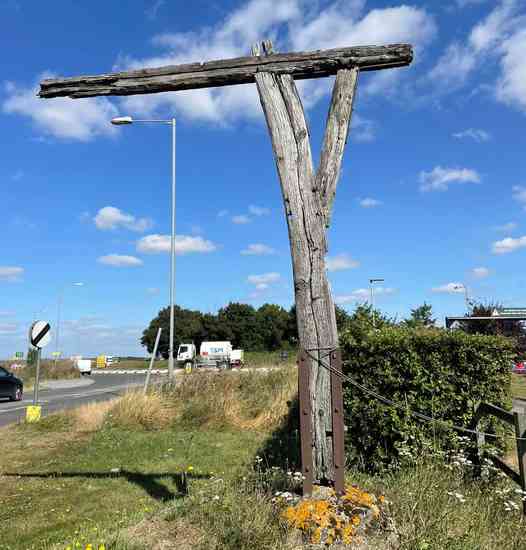
Caxton Gibbet stands as one of England’s most unsettling yet fascinating historical landmarks. Situated in rural Cambridgeshire, this bleak roadside site has captured attention for centuries because of its association with punishment, fear, folklore, and the harsh realities of justice in early modern Britain. Though today it appears as a modest structure beside a busy road, Caxton Gibbet once symbolised authority, deterrence, and public spectacle in an age when the law was enforced with grim visibility.
What Is Caxton Gibbet?
Caxton Gibbet refers to a historic execution and body-display site located on the old Roman road known as Ermine Street. A gibbet was a tall wooden structure similar to a gallows, often fitted with iron cages. These cages held the bodies of executed criminals, left exposed for weeks or months as a warning to others.
Unlike many execution sites that were discreet or short-lived, Caxton Gibbet became notorious because it was placed along a heavily travelled route. Anyone passing through the area would be confronted with a stark message: crime would not go unpunished.
The Origins of Caxton Gibbet
Early Legal Context
In the 1600s and 1700s, England’s legal system relied heavily on public punishment. Theft, highway robbery, and murder were treated with extreme severity. Authorities believed that fear was the strongest deterrent, and Caxton Gibbet served this purpose perfectly.
The location was carefully chosen. Positioned on a major road, it ensured maximum visibility. Merchants, farmers, travellers, and even children would witness the consequences of criminal behaviour.
Establishment of the Gibbet
Historical records suggest that Caxton Gibbet was in use by the late 17th century. Unlike temporary gallows erected for single executions, this gibbet was semi-permanent. It became a recognised landmark, spoken of in court records, travel accounts, and later in local memory.
How the Gibbet Was Used
Execution Versus Display
It is important to understand that Caxton Gibbet was primarily used for display, not execution. Criminals were usually executed elsewhere, often by hanging, and their bodies were then transported to the gibbet.
Once secured in iron cages, the remains were left exposed to the elements. This practice, known as gibbeting, was intended to extend punishment beyond death, stripping criminals of dignity and peace.
Crimes Associated With the Site
Those displayed at Caxton Gibbet were often convicted of:
Highway robbery
Murder
Violent theft
Crimes seen as threats to public order
Highway robbery was particularly feared, as England’s roads were dangerous and poorly policed. Caxton Gibbet stood as a warning to anyone considering attacking travellers along this route.
Legends and Folklore of Caxton Gibbet
The Baker and the Criminal
One of the most persistent legends claims that a criminal was once gibbeted alive and later aided by a compassionate baker who brought him food. According to the tale, when the baker’s kindness was discovered, he too was punished severely.
Historians doubt the accuracy of this story, but its survival reflects how deeply the gibbet embedded itself in the local imagination.
Ghost Stories and Superstition
Like many sites associated with death, Caxton Gibbet attracted ghost stories. Travellers once claimed to hear chains rattling or see shadows near the structure at dusk. Whether superstition or fear, such tales added to the site’s grim reputation.
Caxton Gibbet in Literature and Public Memory
Written Accounts
Writers and commentators of the 18th and 19th centuries referenced Caxton Gibbet as a symbol of harsh justice. It became shorthand for severity and punishment, even for those who had never visited the site.
Cultural Impact
The name “Caxton Gibbet” entered local speech as a point of reference. Even after the original structure disappeared, the crossroads retained the name, demonstrating how powerfully the gibbet had shaped identity and geography.
The Decline of Gibbeting in England
Changing Attitudes to Punishment
By the early 19th century, attitudes towards punishment began to change. Public executions were increasingly seen as barbaric rather than effective. Gibbeting, in particular, faced criticism for being cruel and degrading.
Legal Reforms
In 1834, the practice of gibbeting was formally abolished in England. This marked the end of sites like Caxton Gibbet as functioning instruments of justice.
Soon after, the original structure fell into decay and disappeared from the landscape.
The Modern Replica and Its Meaning
Why a Replica Exists
The structure visible today is a replica, installed in the 20th century to commemorate the site’s history. While it does not perform any judicial function, it serves as a physical reminder of the past.
Public Reaction Today
Modern visitors often react with a mix of curiosity and discomfort. The gibbet provokes questions about morality, justice, and how society treats offenders. Rather than inspiring fear, it now invites reflection.
Caxton Gibbet as a Historical Landmark
Educational Value
Caxton Gibbet is valuable as an educational tool. It provides insight into:
Early modern law
Social control through fear
The evolution of human rights
Teachers and historians often reference the site when discussing the history of punishment in Britain.
Tourism and Awareness
Although not a major tourist attraction, Caxton Gibbet draws history enthusiasts and local visitors. Its roadside location means many encounter it unexpectedly, reinforcing its original purpose of confrontation and visibility.
Ethical Reflections on Caxton Gibbet
Was It Effective?
While authorities believed gibbeting deterred crime, evidence suggests its effectiveness was limited. Crime continued, and public executions sometimes drew crowds more interested in spectacle than moral lessons.
Modern Perspectives
From a modern viewpoint, Caxton Gibbet represents a justice system driven more by fear than fairness. It reminds us of the importance of due process, rehabilitation, and human dignity.
Conclusion
Caxton Gibbet stands as a stark reminder of a time when justice was public, brutal, and unyielding. What was once a tool of fear has become a symbol of reflection, urging modern society to consider how far it has come in matters of law, punishment, and human rights. By preserving the memory of Caxton Gibbet, history challenges us not to repeat its harshness but to learn from it, ensuring that justice continues to evolve with humanity at its core.
FAQs
What is Caxton Gibbet?
Caxton Gibbet is a historic site in Cambridgeshire where the bodies of executed criminals were displayed as a warning to others during the 17th and 18th centuries.
Is the current structure original?
No, the structure seen today is a replica. The original gibbet no longer exists, but the replica marks the historical location.
Why was the gibbet placed on a main road?
It was positioned on a busy route to ensure maximum visibility, reinforcing its role as a deterrent to crime.
Are the legends about Caxton Gibbet true?
Most legends lack solid historical evidence. They are best understood as folklore reflecting local fear and memory.
Can the public visit Caxton Gibbet?
Yes, it is accessible as a roadside landmark, though it functions purely as a historical marker today.