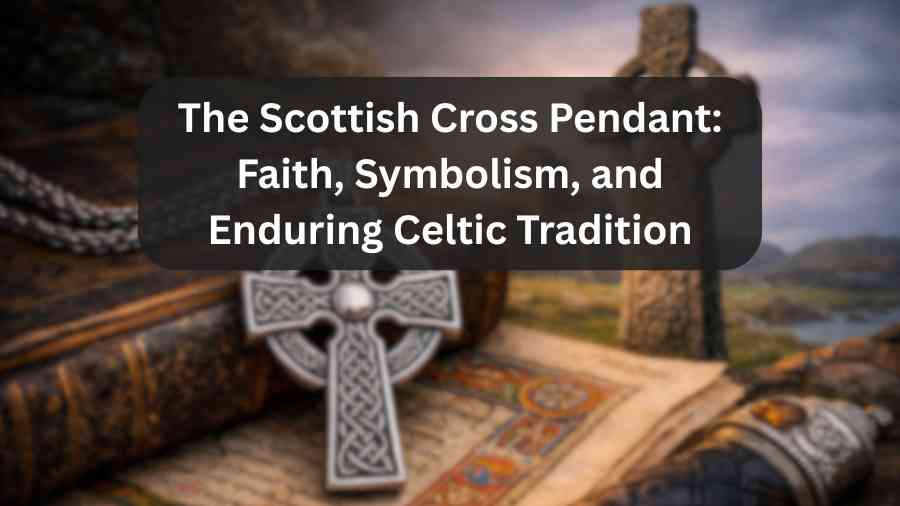
Rooted in early Christian Scotland, the Scottish cross pendant stands at the intersection of faith, cultural identity, and artistic expression, a symbol that has endured across centuries. From carved stone monuments to personal jewellery worn close to the heart, the cross has remained one of the most recognisable and meaningful symbols within Scottish material culture.
Origins of the Cross in Scotland
Christian symbolism reached Scotland during the early medieval period, closely associated with the mission of Saint Columba, who arrived on the island of Iona in the 6th century. From this point onward, the cross became central to religious life, learning, and artistic expression across the region.
Rather than entirely replacing earlier traditions, Christian imagery merged with the existing Celtic visual language. This fusion produced distinctly Scottish forms of the cross that reflected both spiritual belief and cultural continuity.
The Celtic Cross and Its Meaning
Among the most recognisable Scottish forms is the Celtic cross, defined by the ring connecting its arms. Scholars interpret this circle in several ways: as a symbol of eternity, divine unity, or the integration of the spiritual and earthly realms.
Stone examples of these crosses remain visible throughout Scotland, particularly at early monastic centres such as Iona Abbey. Many are preserved and studied under the care of Historic Environment Scotland, offering insight into how religious symbolism shaped public and private life.
From Monument to Personal Pendant
As metalworking skills developed, the cross transitioned from monumental stone carvings to smaller, wearable forms. Cross pendants allowed individuals to carry a visible symbol of faith and identity, often engraved or cast with intricate knotwork inspired by manuscript illumination and ecclesiastical art.
These pendants were not limited to devotional use alone. In periods of political upheaval or cultural suppression, they also served as quiet affirmations of Scottish identity and continuity.
Craftsmanship and Design Traditions
Traditional Scottish cross pendants draw heavily from historical sources, including high crosses, illuminated manuscripts, and early church metalwork. Knotwork patterns symbolise continuity and interconnectedness, while the proportions of the cross itself follow established historical forms rather than modern reinterpretations.
Institutions such as the National Museum of Scotland preserve many of the artefacts that inform contemporary understanding of these designs, ensuring that modern interpretations remain rooted in documented tradition.
The Cross Pendant in Modern Cultural Identity
Today, Scottish cross pendants are worn by people of diverse backgrounds. For some, they remain expressions of Christian faith. For others, they represent ancestry, heritage, or a connection to Scotland’s historical landscape.
Within the Scottish diaspora, such pendants often take on additional meaning, functioning as tangible links to a homeland shaped by memory, tradition, and lineage rather than geography alone.
An Enduring Symbol
The Scottish cross pendant endures because it speaks across time. It reflects a culture shaped by belief, craftsmanship, and continuity. Whether encountered in ancient stone or worn as a personal pendant, the cross remains one of Scotland’s most powerful symbols, bridging past and present through form, meaning, and tradition.
For those seeking deeper insight into Scottish symbolism beyond the cross itself, this knowledge is often preserved by specialist craftsmen who work directly from heraldic records, clan histories, and documented lineage. One such example is Celtic Studio, recognised for its long-standing understanding of Scottish clan crests, heraldry, and traditional Celtic symbolism: https://celticstudio.shop/