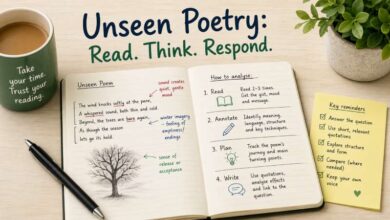
Read the article and learn about the six proven strategies to prepare for a creative ability test in college admissions. It explains how students can build originality, idea fluency and confidence through structured practice and research-based methods.
Have you ever wondered why a creative ability test can shape your college future more than just grades? Many universities now use creativity-based exams to check the ability of students and how they think rather than what they memorise academically. The creative ability test evaluates originality and problem-solving skills of students. Students often feel unsure because creativity feels hard to study. The good news is that the creativity skills can be gained with the right strategies.
Preparing for a creative-based exam does not need artistic talent. It needs a structured pattern of thinking and mental flexibility. Each approach is practical and easy to apply. In this article we will discuss the six strategies for success in the creative ability test for college admission.
What Do You Need To Know Here?
These points help you to grasp the main idea of the article
- The main purpose of the creative ability test is to examine originality and flexibility of thought rather than memorisation, for example, Guilford’s Alternative Uses Task (AUT).
- Creative ability test definitions and purposes help the students to develop a strong mindset.
- Creative ability tests are closely related to divergent thinking exams, which help to measure the capabilities of students to produce original ideas, such as the Torrance Tests of Creative Thinking (TCTT).
- Creativity tests Psychology and learning research help in daily practice and enhance the basic creative knowledge level in students.
- Figural creativity and visual storytelling enable the students to express their creative thoughts in an efficient way, for instance, by drawing images.
The 6 Most Effective Strategies to Prepare for a Creative Ability Test
The preparation strategy to develop the creative ability test skills needs more than just talent. Many students are unable to complete their academic tasks, such as essay writing, while learning creative skills. In such a situation many students prefer the use of professional essay writing services owing to the increasing burden of academic work while learning the new creative skills.
Their PhD writers help the students to provide well-researched academic tasks such as essay writing while learning new skills without raising the workload pressure.
1. Practice Divergent Thinking Daily
All kinds of creative abilities are based on divergent thinking. This refers to how many original creative ideas you can generate from a single task. This skill is important in colleges because it requires the ability to think flexibly.
The daily practice of mock tests for creative exams trains the brain to get out of the habit of laziness. Start with simple exercises. The flow of ideas should not be observed while learning the skills of creative ideas. At this point the quality is more preferable than the quantity.
Research Insight
The ResearchGate study depicts that when divergent thinking is exercised regularly, the scores of originality improve in a major way. Daily practice of idea creation mattered more than short-term ideas. The term refers to creativity as a reaction to repetition.
If you want to practice for a creative exam, use a practice test format from a different sources such as Coursera. Set time limits according to your exam span. Review your ideas later and highlight which one is new. The brain gets trained in a specific situation over time to avoid thinking in critical ways. The divergent practice daily is a major step in preparing for a creative ability test exam.
2. Train Idea Fluency Under Time Pressure
Creative ability tests do not only focus on ideas. They also measure the flow speed of your thinking under pressure situations. The fluency training helps the students to train under pressure situations. Take a mock exam with a rigorous time limit. Improve the ability to generate ideas when they seem unfinished.
A timer helps the students to write a creative answer in a given time. Keep focused to continue to write creative ideas until the time runs out. Such an approach helps you to build mental stamina. The speed of creative writing increases over time.
Research Insight
The Journal of Asian Development Studies studies indicated that timed creative task participants had better scores of fluency and appeared less anxious. They had more free flow of ideas when under pressure. You should include a timed practice test in your routine at least three times per week. Such a strategy helps the students in the creative ability test under exam situations.
3. Learn to Add Detail and Narrative Depth
Many students have good creative ideas but are unable to explain them in an efficient way. The creativity ability tests always prefer depth and storytelling skills. Creative ideas are considered more efficient when they have an emotional touch.
Develop the ability to elaborate on the ideas in an efficient way. Narrative ideas are also helpful incorrelational research because they help to identify the statistical relationship between variables.
Research Insights
Take any single idea and create a short story out of it. This enhances the ability to think expressively. Narrative structure also helps in visual prompts. Abstract shapes can help to tell a story.
Harvard Graduate School of Education indicates that storytelling improves scores in creative evaluation. Examiners always prefer the ideas that contain meaning and coherence. The depth in ideas is significant for learning new ideas. The ability to build the depth of narrative ideas enhances the general performance in exams.
4. Avoid Obvious or Cliché Responses
During creative ability tests, avoid obvious and cliché responses. Most students lose marks because they pick common ideas. It is important to train your mind not to use clichés. Start with identifying the general trends. Go through sample responses and update on common themes.
When you do practice, think about what everyone would write first. Then introduce something new and updated. This habit rewires the level of thinking. It helps the brain to consider unusual associations.
Research Insights:
The Frontier study indicates the test subjects had an improvement in the originality scores, all due to training on suppressing the initial response. Wasting time resulted in more original solutions.
Write down the thoughts that came to your mind first during the practice test. Repeat this process. Such a process would strengthen your creative ability skills for college admission. This approach helps you learn how to use creative skills in your examination hall.
5. Practice Figural Creativity Not Art Perfection
Drawing and visual ideas are used in the assessment of creative abilities. Many students think that they do not have enough art to express their creative ideas, which can be stressful. In fact, the creative ideas should not be judged by the beauty of the context in your test. They evaluate the innovation and creativity in your test. The main focus should be on the idea and not on excellence.
Training helps you to transform the simple objects into meaningful pictures. Add the moment and emotions of the background. Examiners not only appreciate originality but also clarity of your ideas.
Students should frequently be assigned a creative essay task as part of their academic curriculum. Many students struggle to write creative essays. In such cases, essay writing help come in handy. Their PhD writers provide well-managed and structured essays that adhere to academic guidelines.
Research Ideas
An NIH study indicates that the figural creativity scores are also associated with the transformation of ideas that does not prefer skill. Simple drawings with powerful ideas received higher ratings than complex images.
6. Improve Visual Storytelling
Visual storytelling is a combination of emotion and meaning. The most popular method of evaluating interpretation involves using images which help to evaluate the many creative ability tests. Work based on the stories told through drawings. Use images to show sequence, cause and contrast.
Learn the fundamentals of visual aspects such as balance and direction. Be fast in the art of expressing ideas. It is possible to convey powerful messages even with small visuals.
Research Insights:
Wiley online library shows that the students who underwent visual storytelling training, as opposed to those that did not receive such training. Practise theImage-based question for tests. After every attempt, explain your visual selection with words. The thought process enhances better future performances.
Conclusion
Training for the creative ability test needs organisation and mindset. Creativity is not something that a few people possess. It is an ability that is developed on a daily basis. The speed of adding depth to a masterpiece without using cliches and visual telling of stories are creative abilities that enhance the performance of students as well as their confidence level.
Every strategy mentioned in the article is very useful and effective to foster creativity skills. Mock tests and practice test routines transform the uncertainty into certainty. Intentional preparation ensures the dependability of intentional creativity. With the suitable attitude, students are able to meet the expectations of their college and be genuine with original ideas.
Frequently Asked Question About Creative Ability Test
1: What Is a Creative Ability Test, and What Does It Measure?
A creative ability test is an examination that is created to measure the thinking capability of the student. It is an indicator of originality, problem-solving and flexibility of thought. These tests examine the capability of a student to come up with fresh ideas and to link concepts creatively with new conditions.
The idea helps to get to know the creative potential of the student and the way of thinking. Instead of focusing on academic knowledge, the test focuses on innovation and the ability to express ideas in a unique way.
What Tasks Appear In Creative Ability Tests?
Creative testing of ability generally comprises a combination of written and visual idea-based tasks. Students can be requested to come up with various applications of an incomplete drawing or generate a narrative on a photo. There are tests where abstract shapes have to be transformed into meaningful forms of visuals.
Others focus on explaining ideas in a short amount of time. These activities help to measure divergent thinking, imagination, and clarity. The focus is not on the sense of art or excellent language but on originality and idea development.