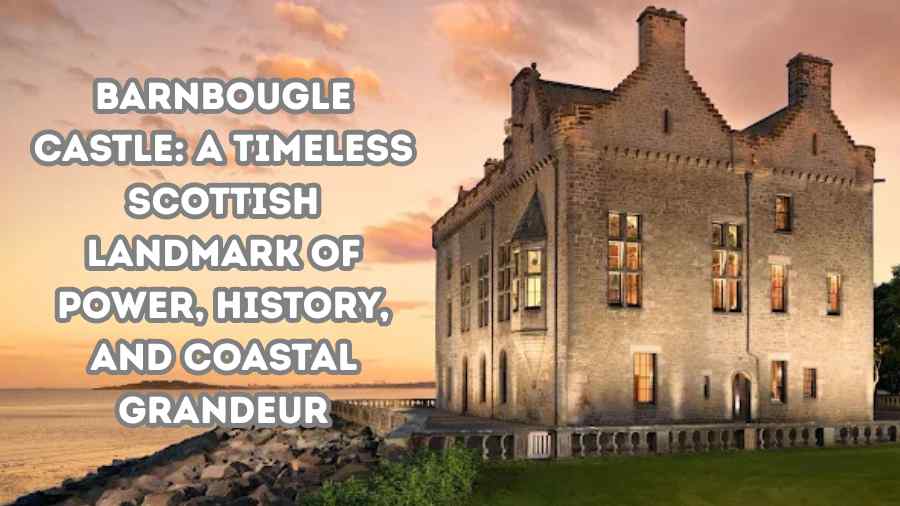
Barnbougle Castle stands as one of Scotland’s most evocative historic residences, rising dramatically above the shoreline of the Firth of Forth. More than a castle of stone and mortar, it is a layered narrative of ambition, political influence, architectural reinvention, and quiet dignity. Nestled within the Dalmeny Estate near South Queensferry, this imposing structure has watched centuries unfold, from medieval skirmishes to Victorian refinement and modern cultural revival.
The Origins of Barnbougle Castle
The story of Barnbougle Castle begins in the medieval period, when Scotland’s coastal regions were strategically vital. The original structure is believed to date back to the 13th century, when fortified tower houses were common among noble families seeking both protection and status. Positioned overlooking the Firth of Forth, the site offered commanding views of maritime routes, making it an ideal defensive and observational location.
Early records associate the castle with the Mowbray family, a Norman lineage with strong ties to Scotland’s feudal elite. At this time, the castle would have been a functional stronghold rather than a grand residence, built for resilience rather than comfort. Thick stone walls, narrow openings, and limited ornamentation reflected a turbulent era defined by shifting alliances and regional conflict.
From Medieval Stronghold to Noble Residence
As centuries passed, Barnbougle Castle changed hands, eventually becoming part of the estates controlled by the Primrose family. This transition marked a significant shift in the castle’s purpose. No longer solely a defensive outpost, it began to take on the character of a noble residence, reflecting the growing stability and wealth of its owners.
By the 17th century, the Primrose family had established themselves as influential figures within Scottish society. Their stewardship of the castle aligned with a broader trend among the aristocracy, transforming austere fortresses into symbols of lineage, learning, and cultural refinement. Yet despite these changes, the structure retained its medieval core, anchoring it firmly to its past.
Architectural Transformation in the Victorian Era
One of the most defining chapters in the history of Barnbougle Castle occurred in the late 19th century. By this time, the original building had fallen into a state of neglect. Rather than abandoning it, Archibald Primrose, the 5th Earl of Rosebery, undertook an ambitious restoration project.
The Earl was not merely a landowner but a prominent political figure with a deep appreciation for history and architecture. Under his direction, the castle was extensively rebuilt in the Scots Baronial style, a romantic architectural movement that sought to revive Scotland’s medieval aesthetic while incorporating Victorian comfort and craftsmanship.
This transformation did not erase the past. Instead, it reinterpreted it. Medieval elements were preserved and integrated into a grander vision, resulting in a structure that feels both ancient and purposeful. Crow-stepped gables, turrets, and battlements gave the castle a dramatic silhouette, while the interiors were redesigned to serve intellectual and social pursuits rather than military defence.
The Castle as a Centre of Learning and Reflection
Unlike many grand estates designed primarily for entertainment, Barnbougle Castle was envisioned as a place of study and contemplation. The Earl of Rosebery used it as a private retreat, particularly valuing its libraries. These rooms, filled with books and natural light, reflected a belief in knowledge as a form of power equal to land or title.
The atmosphere within the castle encouraged quiet reflection. Rather than opulent ballrooms, the focus was on intimate, thoughtful spaces. This intellectual character sets Barnbougle Castle apart from many other historic properties, giving it a personality shaped as much by ideas as by heritage.
A Landscape Shaped by Sea and Stone
The setting of Barnbougle Castle is inseparable from its identity. Perched above the coastline, it commands sweeping views across the Firth of Forth. The interplay between sea, sky, and stone creates a sense of isolation and authority, reinforcing the castle’s presence as both guardian and observer.
The surrounding grounds form part of the Dalmeny Estate, a landscape carefully managed over generations. Woodlands, open parkland, and coastal paths frame the castle, enhancing its sense of timelessness. The natural environment does not merely complement the architecture; it elevates it, providing context and contrast that deepen its visual and emotional impact.
Historical Significance and National Importance
Barnbougle Castle holds the highest level of heritage protection in Scotland, reflecting its architectural and historical value. This status recognises not only the building itself but its role within the broader narrative of Scottish history.
The castle is closely linked to political life through the Primrose family, particularly during the late 19th and early 20th centuries. Its association with national leadership adds a layer of significance that extends beyond local heritage. Barnbougle Castle is not simply a relic of the past; it is a witness to moments that shaped modern Britain.
Decline and Preservation in the Twentieth Century
Like many historic properties, Barnbougle Castle faced challenges during the twentieth century. Changing economic conditions and the high cost of maintenance led to periods of limited use. However, unlike many castles that fell into irreversible decay, Barnbougle was preserved with care.
Efforts to stabilise and maintain the structure ensured that its architectural integrity remained intact. These measures laid the groundwork for its eventual revival, demonstrating the importance of long-term stewardship in protecting national heritage.
A Modern Revival with Respect for the Past
In recent years, Barnbougle Castle has entered a new phase of life. Sensitive restoration work has prepared it for limited modern use while respecting its historic character. Today, the castle serves as an exclusive venue for carefully selected events, allowing visitors to experience its grandeur without compromising its preservation.
This modern role has reintroduced Barnbougle Castle to public awareness. It has become a sought-after setting for weddings, cultural gatherings, and formal occasions, valued for its atmosphere as much as its beauty. Importantly, this use supports ongoing conservation, ensuring that the castle remains structurally sound and historically authentic.
Cultural Impact and Public Perception
Barnbougle Castle occupies a unique position in Scotland’s cultural imagination. It is less commercialised than many historic sites, which enhances its mystique. Rather than being defined by crowds and tourism infrastructure, it retains an air of exclusivity and quiet authority.
This balance between accessibility and preservation has contributed to its reputation as a refined and meaningful heritage site. Visitors often describe the experience as deeply personal, shaped by the castle’s history, setting, and understated elegance.
Why Barnbougle Castle Continues to Matter
The enduring relevance of Barnbougle Castle lies in its ability to adapt without losing its identity. It represents a continuity of purpose, evolving from fortress to residence, from private retreat to cultural venue. Each phase has added depth rather than replacing what came before.
In a world where historic buildings are often reduced to backdrops or commercial attractions, Barnbougle Castle offers a different model. It demonstrates how heritage can be lived with, respected, and integrated into modern life without sacrificing authenticity.
Conclusion
Barnbougle Castle stands as a powerful symbol of Scotland’s layered history. From its medieval beginnings to its Victorian reinvention and modern revival, it embodies resilience, intellect, and architectural grace. Its coastal setting, thoughtful design, and historical associations combine to create a place that feels both monumental and intimate.
More than a landmark, Barnbougle Castle is a reminder that history is not static. It lives on through careful preservation, meaningful use, and a continued respect for the stories embedded within stone walls. As Scotland looks to the future, Barnbougle Castle remains a steadfast link to the past, dignified, enduring, and profoundly relevant.